Why We Need to Follow the Sunnah?
When converting to Islam, the questions about one’s new faith seem endless.

“How often do I pray, Where can I pray? When do I fast? When can I make up fasts missed?
How much zakat do I give? If I can’t afford pilgrimage to Makkah, do I have to perform it?…”
One particular question I hear a lot of new Muslims asking is in regards to the Sunnah (the Prophet’s tradition). Many wonder:
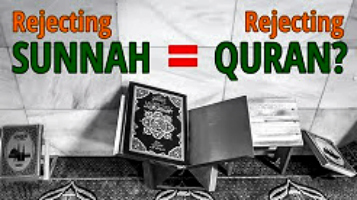
“If the Quran is superior and more authentic than the Sunnah, why learn or practice the Sunnah?”
What the question boils down to is not understanding why there is a need to follow the Prophet’s traditions when we have the Quran. This is a very good question and shows that the new convert is thinking and studying.
The answer to this profound question can be found in the Quran itself.
Following Quran is Following Sunnah
Allah answers the question of the Sunnah directly and in many places in the Quran.
Allah tells us that following the Quran is to follow the example of the Prophet Muhammad (peace be upon him), or the Sunnah.
Allah says:
Believe in Allah and His Messenger and the light which He sent down. (64:8)
We sent you (Muhammad) as a witness and a bringer of good news and a warner so that they might believe in Allah and His Messenger. (48:8-9)
Believe in Allah and His Messenger, the unlettered Prophet. (7:158)
Take what the Messenger brings you. (59:7)
You have a good model in the Messenger of Allah for one who hopes for Allah and the Last Day. (33:21)
And it is related from Al-Hasan Al-Basri that some people said:
“Messenger of Allah, we love Allah,” so Allah revealed:
Say: if you love Allah, follow me and Allah will love you (3:31).

So if we are to follow the Quran that would also include following the Sunnah.
What is the Sunnah
As we see in the Quran, if we love Allah, wish to follow the Quran and its message, we must follow the Sunnah. But what does that mean?
“The Sunnah is everything besides the Quran that came from God’s Messenger. It explains and provides details for the laws found in the Quran. It also provides examples of the practical application of these laws.
It is also either direct revelation from God, or decisions of the Messenger that were then confirmed by revelation. Therefore, the source of all the Sunnah is revelation.” (islamreligion.com)
Sunnah literally means the path or the way. The Arabic word hadith is very similar to Sunnah, but not identical. A hadith is a narration about the life of the Prophet Muhammad or what he approved – as opposed to his life itself, which is the Sunnah. Both the Quran and Sunnah are essential; one cannot practice Islam without consulting both of them – as the Quran tells us.
What Does it All Mean?
The further away we get from the time of the Prophet, it seems that there are more misconceptions about what the Quran is telling us.
We see it in groups that twist its meaning to gain political ends. We see groups who wish to twist it to demonize Islam. And we see those who innocently misread its text. The way we view any text will differ from person to person depending on our level of understanding and the context from which we approach the text.
Even the Quran was understood differently by different companions of the Prophet, despite its clarity and having been revealed in seven different dialects for the utmost ease of discernment. But when we look to the companions, we see that they themselves referred to the Sunnah of the Prophet when questions of interpretation arose.
“The Prophet (peace be upon him) knew and understood the Quran completely because Allah had chosen him as its vehicle and explained it all to him. Hence Allah said in one verse:
Verily, collecting the Quran and reciting it (to you) is Our responsibility, so if We read it to you, listen to it. Then We will explain it. (75:17-9)
It was, therefore, the Prophet’s job to explain the Quran to his followers by his actions as well as his statements.” said Dr. Bilal Philips.
The Reason for the Messengers
If Allah had willed He would have only sent a book(s) to guide mankind and not sent it through a messenger. But Allah didn’t only send down a book. Allah sent the Quran to the Prophet Muhammad (peace be upon him).
Allah informed Prophet Muhammad (and all prophets) of the divine revelation and appointed him to convey it, explain it, and live it as an example to humankind.
As a mercy to humankind, Allah sent a book of truth—the Quran—and an example of how to live according to it—The Prophet Muhammad. {Verily, We have revealed the Reminder (Quran to you O Muhammad) so that you may explain to people what has been revealed to them. (16:64)
It is in the human nature to want to follow the example of others. To understand this, one has only to look at how teenagers emulate actors and musicians. This natural inclination to emulate is a part of our nature so that we will follow the example of those who were the best of humankind in the eyes of Allah.
The answer to “why follow the Sunnah” is found directly in the Quran and built in to our very nature.
(From Discovering Islam’s archive.)
The post Why We Need to Follow the Sunnah? appeared first on About Islam.
source https://aboutislam.net/reading-islam/about-muhammad/why-we-need-to-follow-the-sunnah/


Comments
Post a Comment