
How It Feels Like to Flee Your Home and Be a Refugee

You’re 29 years old with a wife, two children and a job. You have enough money, and can afford a few nice things, and you live in a small house in the city.

Suddenly the political situation in your country changes and a few months later, soldiers are gathered in front of your house and in front of your neighbors’ houses. They say that if you don’t fight for them, they will shoot you. Your neighbor refuses and gets shot. That’s it.
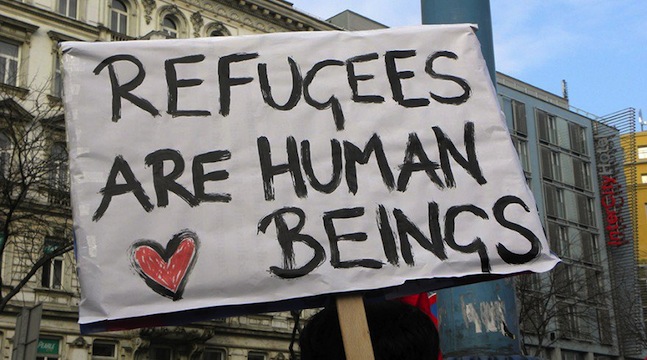
You see one of the soldiers trying to rape your wife. Somehow you get rid of the soldiers and spend the night deep in thought. Suddenly you hear an explosion. Your house no longer has a living room. You run outside and see that the whole street is destroyed. Nothing is left standing.

You take your family back into the house, and then you run to your parents’ house. It is no longer there, nor are your parents. You look around and find an arm with your Mother’s ring on its finger. You can’t find any other sign of your parents.

“But asylum seekers have so many luxury goods! Smartphones and designer clothes!”

 ************

You immediately forget it. You rush home, and tell your wife to get the children dressed. You grab a small bag, because anything bigger will be impossible to carry for a long time, and in it you pack essentials. What do you take? You will probably never see your home country again. Not your family, not your neighbors, your workmates… But how can you stay in contact?

You hastily throw your smartphone and the charger in the bag, along with the few clothes, some bread and your small daughter’s favorite teddy.

“They can easily afford to get away. They aren’t poor!”

**************

Because you could see the emergency coming, you have already scraped all your money together. You managed to save some money because of your well paid job. The smuggler in your neighborhood charges 5,000 euros per person.

You have 15,000 euros. With a bit of luck, you’ll all be able to go. If not, you will have to let your wife go. You love her and pray that the smugglers will take you all. By now you are totally wiped out and have nothing else. Just your family and the bag. The journey to the border takes two weeks on foot.

You are very hungry as you’ve barely eaten for the last week. You are weak, as is your wife. But at least the children are okay although they don’t stop crying.

Half the time you have to carry your younger daughter. She is only 21 months old. A further 2 weeks and you arrive at the sea.

In the middle of the night you’re loaded onto a ship with other refugees. You are lucky: your whole family can travel. The ship is so full that it threatens to capsize. You pray that you don’t drown. The people around you are crying and screaming. A few small children have died of thirst. The smugglers threw them overboard.

The post How It Feels Like to Flee Your Home and Be a Refugee appeared first on About Islam.


source https://aboutislam.net/family-life/muslims-4-humanity/how-it-feels-like-to-flee-your-home-and-be-a-refugee/

Comments

Popular posts from this blog

List of Times and Places Where Dua is Accepted

A short reminder regarding the recommended times of dua . And I think what you need to know here is that the recommended times of dua or recommended things that can cause your dua to be accepted, can be divided into two sort of large groups: Am I Good Enough to Make Dua for Myself? Situations where your dua is accepted. Times where your dua is accepted So I’m going to very briefly mention them one after the other as much as possible. As for situations where your dua has been accepted: – The person who has been wronged or oppressed . – A person who finds themselves in severe difficulty after a calamity has struck. – The person who is traveling. – Someone who is fasting. – The one who is reciting the Quran or has just recited the Quran – Someone who is performing Hajj or Umrah or jihad. – The one who is making dua for someone in their absence . Because we know that when you make dua for someone in his absence an angel says: “ Ameen and to you”. – A person...

Ghuraba (The Strangers): Nasheed with English Subtitles

Islam began as something strange, and it shall return to being something strange, so give glad tidings the strangers. (Sahih Muslim 145) This famous nasheed has many versions; this one is from Muhammad al-Salman and has the subtitles in English embedded. [We are] strangers and we do not bow the foreheads to anyone besides Allah  […] Transliteration to help in the pronounciation:  Ghurabaa’ wa li ghairillaahi laa nahnil jibaa Aisha Stacey  wrote in an article for Aboutislam.net : “I think that many of you would agree that being Muslim in the 21st century makes you well acquainted with being strange. It might even be a metaphor for random, as in you have been randomly selected. […] many converts to Islam will tell you about feeling as if they were strangers, before finding Islam. They will speak of feeling that they belonged somewhere else that their lives were just slightly off center. They often speak about a vague sense of knowing they were not like everyone else...

Taqwa – Living the Main Purpose of Ramadan

Taqwa is a major purpose for the month of Ramadan. The people of taqwa are those who do the things that they are commanded and avoid the things which Allah has made prohibitive. And evidently, to reach a state of taqwa requires vigilance, it requires patience and sincerity. The verse is pertaining to fasting I found in a single set of verses in chapter 2 starting at verse 183: O you who have believed, decreed upon you is fasting as it was decreed upon those before you that you may become righteous. ( 2:183 ) A Collective Act of Worship Allah is telling us that fasting has been made obligatory and then Allah tells us that just as it was prescribed for those before us. We often get asked this question in Ramadan, “how’s the fast going for us?” And if we gave ourselves a moment to think about it, we see that Allah Most High has made the fast inside the month of Ramadan easy for us because we know that there is a collective spirit to fasting; we know that we’re not alone in this ...