With Pilgrims Day by Day – Dhul-Hijjah 9, Day of Arafah
Dhul-Hijjah 9 is a very special day. The Day of Arafah, one of the most blessed days of the year, is named after the place where pilgrims gather on this day, Arafah.
Rituals of Dhul-Hijjah 9

After the sun rises on Dhul-Hijjah 9, pilgrims leave Mina to Arafah.
Staying in Arafah is a major pillar of Hajj. The Prophet said, “Hajj is (staying in) Arafah.“
The time for staying in Arafah starts from the Zhuhr Prayer of Dhul-Hijjah 9 and ends at the Fajr Prayer on Dhul-Hijjah 10.
Staying for any portion of time within this range is acceptable. The Prophet stayed in Arafah until the sun set, and therefore some scholars hold that pilgrims should not leave Arafah before sunset.
The preponderant opinion, however, is that this is not necessary, especially if there is a need for leaving `Arafah earlier.
In Arafah, you pray Zhuhr and Asr, joining them at the time of Zhuhr if possible, and shortening each of them to two rakahs.
While being in Arafah, you should busy yourself with dhikr, duaa, and asking for Allah’s forgiveness. The Day of Arafah is a very blessed day. Aishah (may Allah be pleased with her) narrated that the Prophet (peace and blessings be upon him) said,
There is no day in which Allah frees a greater number of His slaves from the Hellfire than the Day of `Arafah. Allah comes close to His slaves and boasts about them to the angels, then asks (a rhetorical question): “What do these slaves seek?” (Muslim)
 Read Also: Day of Arafah: Please Explain Its Significance
The Prophet (PBUH) also said,
The best supplication is that of the Day of Arafah, and the best thing that I and other Prophets before me said, is:
La ilaha illa allahu wahdahu la sharika lah, lahu al-mulku wa lahu al-hamdu wa huwa `ala kulli shai’in qadeer.
There is no god but Allah alone. He has no partners. To Him belong the sovereignty and all praise. He has power over all things.
Mistakes to Be Avoided at Arafah
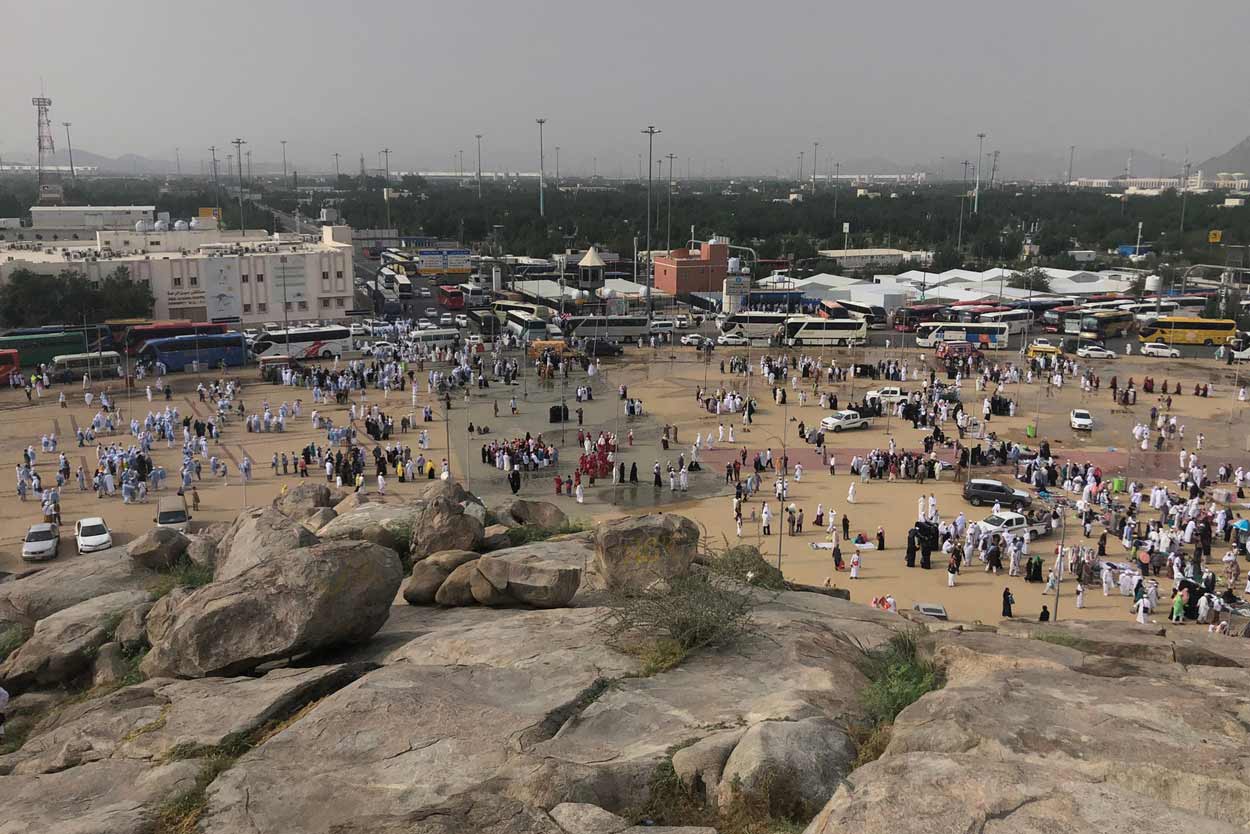
1- Some pilgrims do not recite the Talbiyah aloud on their way from Mina to Arafah. It was proven that the Prophet (peace and blessings be upon him) continued to recite the Talbiyah until he threw the pebbles of Al-`Aqabah on the day of Eid.
2- One of the most serious mistakes that some pilgrims make is to stop outside Arafah and then stay there until the sun sets, after which they leave for Muzdalifah. Those who stand in these places have not performed Hajj. There are big and clear signs showing the boundaries of `Arafah.
3- Some people think that they have to go to the place where the Messenger of Allah (peace and blessings be upon him) stood beside the mountain and to stand there. They put themselves through a lot of trouble in order to reach that place. This is wrong. The Prophet (peace and blessings be upon him) said, “I am standing here but all of Arafah is the place of standing.“
4- Some pilgrims think that the mountain by which the Prophet (peace and blessings be upon him) stood is holy, so they go and climb it seeking blessings from the stones and soil around it. These are unacceptable bid`ahs (innovations in religion).
5- Some people think that it is essential to pray Zhuhr and Asr Prayers with the imam in the mosque, seeking that place from far away. This causes them a great deal of difficulty and many of them go astray. There is no need for all of that. It is enough to pray in your place.
The Night of Dhul-Hijjah 9

After spending some time in Arafah, preferably from Zhuhr till Maghrib Prayers, you leave to Muzdalifah. On your way from Arafah, keep remembering Allah and seeking His forgiveness.
On reaching Muzdalifah, join Maghrib and Isha Prayers at the time of the latter; three rakahs for Maghrib and two for Isha.
If you fear that you may miss these prayers due to the throng of people at Muzdalifah, then you may perform prayers on your way to it. Then when you reach Muzdalifah, you can sleep till dawn. This is the Sunnah of the Prophet. However, according to some scholars you can leave after midnight. The Maliki school even holds that it is adequate to pray Maghrib and Isha in Muzdalifah, have a meal, and then leave for Mina.
Take note of this: Muzdalifah is an open area; you will find no tents there. So remember to ask your journey’s organizers if they will provide you with blankets or sleeping bags; these will prove very useful, especially if it is cold that night.
The post With Pilgrims Day by Day – Dhul-Hijjah 9, Day of Arafah appeared first on About Islam.
source https://aboutislam.net/shariah/special-coverage-shariah/hajj-and-umrah/with-pilgrims-day-by-day-dhul-hijjah-9-day-of-arafah/


Comments
Post a Comment