
Pilgrims Ascend Arafat in Minimized Hajj Climax

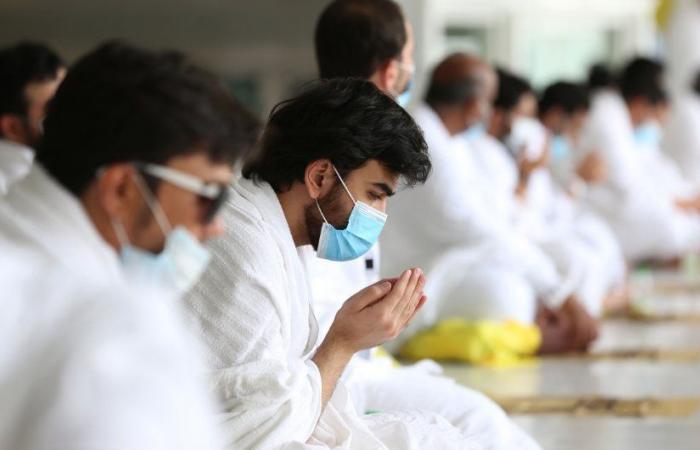
Seeking forgiveness from Allah, Muslim pilgrims ascended Mount Arafat, east of the holy city of Makkah, on Thursday, July 30, in the climax of a very different hajj due to coronavirus.

Pilgrims had flocked to `Arafat, also known as “Mount of Mercy”, since early morning, after spending a night of meditation and introspection in the tent city of Mina which marked the first leg of their five-day spiritual journey.

Chanting “Labbaik Allahumma Labbaik (Here I am answering Your call, O God),” the pilgrims took their way to `Arafat, where Prophet Muhammad (peace and blessings be upon him) delivered his last sermon 14 centuries ago.

📚 Read Also: Check Our Coverage of Hajj 1441 (Special)

“This is an indescribable feeling,” said Mohamed Ibrahim, 43, an Egyptian electrician from Madinah, Arab News reported.

“It feels like a dream.”

Following the lead of the Prophet’s Sunnah, the pilgrims performed noon and afternoon prayer “Dhuhr and Asr” combined and shortened at the Namera Mosque.

Pilgrims spend the day on the plains of `Arafat in the most essential pillar of hajj.

For the rest of the day, the pilgrims supplicate to God to forgive their sins and grant them mercy and pray for fellow Muslims, and for unity and peace around the world.
Later to Muzdalifah

Pilgrims then will descend by train back to Muzdalifah, halfway between Arafat and Mina, where they will take part in the symbolic gathering of pebbles for a ritual of stoning the devil at Jamrat Al-Aqaba.

On Friday, all pilgrims head back to Mina, where they will sacrifice animals to mark the beginning of the four-day `Eid Al-Adha.

Muslims who perform hajj properly return to their homes all their sins washed away as promised by Prophet Muhammad.

Every year, Makkah sees millions of Muslims from around the world pouring to perform hajj, one of the five pillars of Islam.

This year, Hajj is like no other due to the global COVID-19 pandemic, which has forced Saudi government to cut the number of pilgrims to only 1000 to curb the spread of the deadly virus.

Hajj’s ceremonies symbolize the essential concepts of the Islamic faith and to commemorate the trials of Prophet Abraham and his family.

Every able-bodied adult Muslim who can financially afford the trip must perform hajj at least once in a lifetime.

The post Pilgrims Ascend Arafat in Minimized Hajj Climax appeared first on About Islam.


source https://aboutislam.net/muslim-issues/world/pilgrims-ascend-arafat-in-minimized-hajj-climax/

Comments

Popular posts from this blog

List of Times and Places Where Dua is Accepted

A short reminder regarding the recommended times of dua . And I think what you need to know here is that the recommended times of dua or recommended things that can cause your dua to be accepted, can be divided into two sort of large groups: Am I Good Enough to Make Dua for Myself? Situations where your dua is accepted. Times where your dua is accepted So I’m going to very briefly mention them one after the other as much as possible. As for situations where your dua has been accepted: – The person who has been wronged or oppressed . – A person who finds themselves in severe difficulty after a calamity has struck. – The person who is traveling. – Someone who is fasting. – The one who is reciting the Quran or has just recited the Quran – Someone who is performing Hajj or Umrah or jihad. – The one who is making dua for someone in their absence . Because we know that when you make dua for someone in his absence an angel says: “ Ameen and to you”. – A person...

Ghuraba (The Strangers): Nasheed with English Subtitles

Islam began as something strange, and it shall return to being something strange, so give glad tidings the strangers. (Sahih Muslim 145) This famous nasheed has many versions; this one is from Muhammad al-Salman and has the subtitles in English embedded. [We are] strangers and we do not bow the foreheads to anyone besides Allah  […] Transliteration to help in the pronounciation:  Ghurabaa’ wa li ghairillaahi laa nahnil jibaa Aisha Stacey  wrote in an article for Aboutislam.net : “I think that many of you would agree that being Muslim in the 21st century makes you well acquainted with being strange. It might even be a metaphor for random, as in you have been randomly selected. […] many converts to Islam will tell you about feeling as if they were strangers, before finding Islam. They will speak of feeling that they belonged somewhere else that their lives were just slightly off center. They often speak about a vague sense of knowing they were not like everyone else...

Taqwa – Living the Main Purpose of Ramadan

Taqwa is a major purpose for the month of Ramadan. The people of taqwa are those who do the things that they are commanded and avoid the things which Allah has made prohibitive. And evidently, to reach a state of taqwa requires vigilance, it requires patience and sincerity. The verse is pertaining to fasting I found in a single set of verses in chapter 2 starting at verse 183: O you who have believed, decreed upon you is fasting as it was decreed upon those before you that you may become righteous. ( 2:183 ) A Collective Act of Worship Allah is telling us that fasting has been made obligatory and then Allah tells us that just as it was prescribed for those before us. We often get asked this question in Ramadan, “how’s the fast going for us?” And if we gave ourselves a moment to think about it, we see that Allah Most High has made the fast inside the month of Ramadan easy for us because we know that there is a collective spirit to fasting; we know that we’re not alone in this ...