Overcoming Cultural Differences in an Intercultural Marriage
Once you’re one half of an intercultural marriage, you are set to experience all the challenges and blessings it brings.

While intercultural marriages can have their difficulties, one of the blessings of Islam is that sharing a common religion can smooth over some of the rough edges.
Having a shared religion makes it easier to choose how to raise the children and which holidays to celebrate, and it takes the pressure off of participating in un-Islamic activities.
When a couple shares Islam, it becomes easier for them to find common ground.
An intercultural Islamic couple can turn to the teachings of their religion and people of knowledge to get answers to any questions that come up.
Ensuring Deen Comes First
Allah commands us to look to the Quran and Allah’s Messenger Muhammad, peace and blessings be upon him, for guidance.
Allah says,
“O you who have believed, obey Allah and obey the Messenger and those in authority among you. And if you disagree over anything, refer it to Allah and the Messenger, if you should believe in Allah and the Last Day. That is the best [way] and best in result” [Quran, Surat An-Nisaa 4:59]
Many common challenges in an intercultural marriage can be solved by seeking wisdom from these two sources.
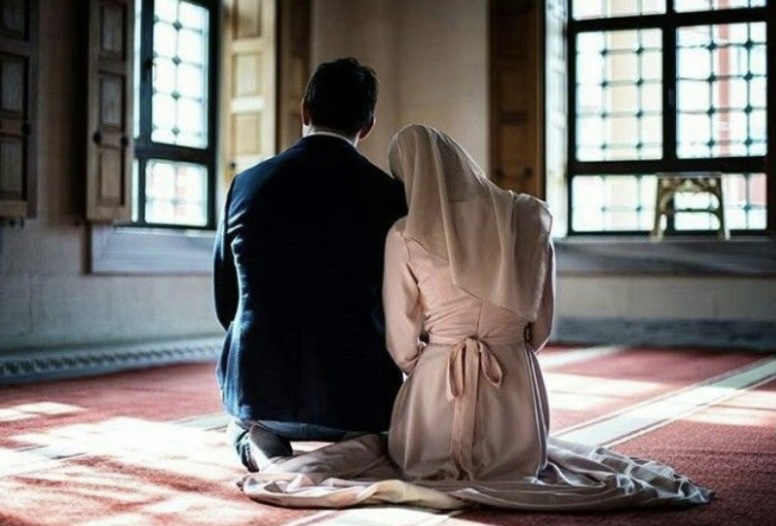
The guidance about many of our relationship and family problems exist in these texts and traditions.
It’s appropriate to seek out those answers if a couple does run into cultural issues or difficulties.
What Islam Says About Race and Culture
Additionally, Allah created all the different languages, cultures, and skin colors as a display of his power, creativity, and foresight.
Allah says,
“Among His signs is the creation of the heavens and the earth and the diversity of your languages and your colors. Verily, in that are signs for people of knowledge.” [Quran, Surat Ar-Rum, 30:22]
Allah also says,
“O people, We have created you male and female and made you nations and tribes that you may know one another. Verily, the most noble of you to Allah is the most righteous of you. Verily, Allah is knowing and aware.” [Quran, Surat Al-Hujurat, 49:13]
Our gendered and cultural differences were designed by Allah so that we could rise to the challenge of understanding others that we share this planet with.
I can think of no greater challenge or way to get to know someone than to marry them!
No One is Better Than Another Except in Religion
As Muslims, we are taught that it is our good and bad deeds that ultimately count in the end and “color” our personality.
Abu Nadrah reported: “I heard the farewell sermon of the Messenger of Allah, peace and blessings be upon him, and he said:
“O people, your Lord is one and your father Adam is one.
There is no virtue of an Arab over a foreigner nor a foreigner over an Arab, and neither white skin over black skin nor black skin over white skin, except by righteousness. Have I not delivered the message?” [Musnad Ahmad 22978]
Letting Go of the Bad Behaviors of Our Ancestral Cultures
While we can be thankful to our ancestors and families for instilling Islamic values in us from childhood, we must also remember to part ways with those behaviors that are incompatible with Islamic teachings.

Abu Huraira reported: “The Messenger of Allah, peace and blessings be upon him, said:
“Verily, Allah has removed from you the pride of the time of ignorance with its boasting of ancestors. Verily, one is only a righteous believer or a miserable sinner. All of the people are the children of Adam, and Adam was created from dust.” [Sunan At-Tirmidhi 3955]

Ending Tribalism
It’s not right to boast about or feel pride in one’s cultural superiority.
One should only take what is good and Islamic from our cultures and leave the rest.
Jubair ibn Mut’im reported: The Messenger of Allah, peace and blessings be upon him, said:
“He is not one of us who calls to tribalism. He is not one of us who fights for the sake of tribalism. He is not one of us who dies following the way of tribalism.” [Sunan Abu Dawud 5102].
***
Tha article is from our archives.
The post Overcoming Cultural Differences in an Intercultural Marriage appeared first on About Islam.
source https://aboutislam.net/family-life/husbands-wives/overcoming-cultural-differences-intercultural-marriage/


Comments
Post a Comment