British Muslim Walks to Makkah, Aims to Inspire Youth
Muslim pilgrimage or hajj is a lifetime journey that many aspire to.
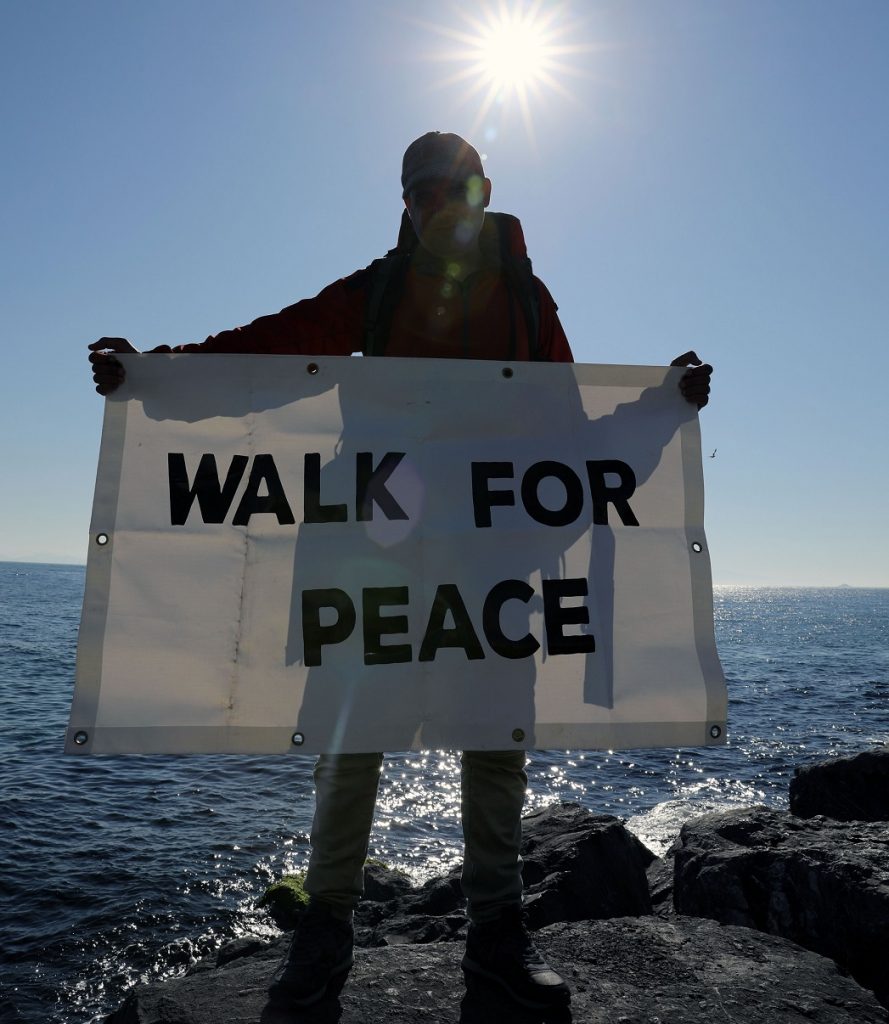
For British Muslim Farid Feyadi, he wanted to make it an unforgettable journey to inspire the young generation and prove to the world that Muslims are peaceful.
“As a Muslim, I believe each of us is an ambassador of this religion, we have a big responsibility on our shoulders to represent Islam and Muslims in the best way to the world. I tried to do something in the very peaceful and show Islam is a wave of peace and comes from Salaam,” he told Anadolu Agency.
He kicked off his project, Walk for Peace, last November 3. In the beginning, he thought of making the journey by bicycle. Then, he changed his mind.
“I started this journey on Nov. 3, 2019. I have never experienced traveling like this, I have traveled by plane, I booked nice hotels, but never like this.”
“I was so excited!” he added.
Feyadi plans to arrive in the sacred city of Makkah, where millions of Muslims journey every year, in July, as the scorching summer heat takes hold of the region.
“I’ve walked 4,000 km [2,485 miles] to Istanbul. I pushed myself very hard to arrive in Istanbul,” he said, adding that he had roughly 2,700 km to go.
Enduring all this, Feyadi hopes to inspire hope in cancer patients the world over.
“I’m a kidney cancer survivor, I live with one kidney. I’m doing this project and I walk between 60 km every day. All this blessing comes from Allah. If he wouldn’t help, I wouldn’t reach here. I’ve been in the heavy rain, snow and cold water,” he said.
Inspire Others
Feyadi hopes to be an inspiration to future generations and deliver a message to the world.
“My achievement is delivering a message that ‘Islam is peace, Muslims are peaceful people’,” he said, hoping that this would inspire the “young generation” to persevere in leaving their “fingerprint on the planet.”
“I’m doing this and going to the holiest place in the world,
“I want to deliver a message to the world and also to Muslims: Whenever you receive an objection from […] the world, have a pure intention, pure heart. Open your heart to the world with peace and love,” he said.
He even wants to make more journeys in the future, this time with fellow travelers.
“I have a Spanish-background Muslim friend. Two years ago, he [traveled] from Paris to Mecca by walking. There is a lovely Chinese friend of ours who grew up in Paris and converted to Islam. We are planning to do this walk to Mecca again — or by bicycle — we haven’t decided yet,” explained Feyadi.
“But my idea is, I want to make a group of about 20 people from every background, country or ethnicity, as a small ummah,” he added.
Similar Journeys
There have been previous similar adventures, especially with regard to performing Hajj.
Last month, a group of four Kenyan cyclists and two support members embarked on a lengthy trip from Nairobi to Makkah to perform Hajj and raise funds to educate needy children in Kenya.
In 2018, a family of five Indonesian Muslims took a lengthy cycling journey of 13,000 km to Makkah to perform Hajj.
In 2017, another Indonesia Muslim walked more than 9,000 kilometers to perform Hajj.
In 2012, 47-year-old Bosnian Muslim, Senad Hadzic, reached the holy city of Makkah on foot to perform Hajj.
During his journey, the man walked for nearly 3,600 miles (5,900 km) from his Bosnian village to the holy city of Makkah.
The post British Muslim Walks to Makkah, Aims to Inspire Youth appeared first on About Islam.
source https://aboutislam.net/muslim-issues/europe/british-muslim-walks-to-makkah-aims-to-inspire-youth/


Comments
Post a Comment