We Approximate Pi & Allah Knows Best
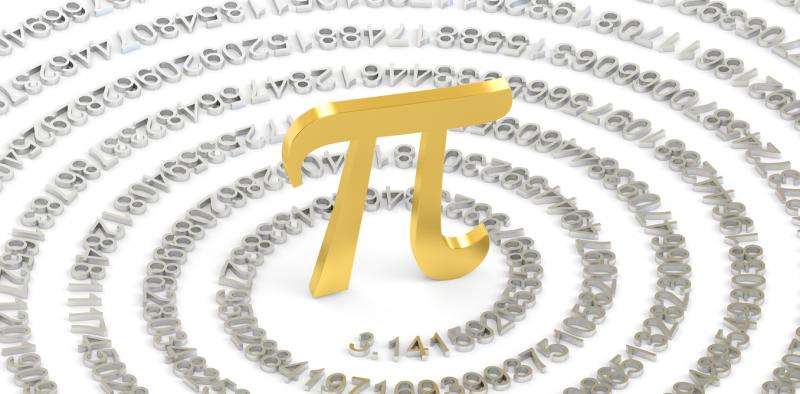
Pi is a mathematical value full of historical mystery and wonder.
Termed an ‘irrational number’, pi cannot be expressed as a simple fraction, nor accurately calculated by dividing two integers.
Equally intriguing, pi’s digits apparently extend infinitely beyond the decimal point without any logical pattern.
What is Pi?
Useful for calculating sizes, areas, and volumes of circles, spheres, cones, and cubes, pi is the ratio of the circumference of a circle to its diameter.
For example, measuring a dinner plate, the circumference might be 82 centimeters/32.2835 inches, and the diameter about 26 centimeters/10.2362 inches.
Without extremely accurate measurements of the plate, our modern calculators give us roughly 82cm/26cm=3.1538461… or 32.2835in/10.2362in=3.1540024…
However, determining pinpoint accuracy of pi is among the greater mathematical challenges of history.
Although meticulously studied by today’s supercomputers, as well as the greatest mathematical minds of every age since the notion of pi was conceived around 2,000BCE, calculations haven’t yet reached the finite value of pi.
For practical uses, no more than two decimal places are needed for making reasonably accurate calculations, but, in fact, pi has been calculated to over two quadrillion decimal places. Even so, no end has yet been calculated.
Measured as accurately as humanly possible at this time, the standard value of pi (without knowing the full end of it), is approximately equal to 3.14159265358979323846….
Islamic Contributions to Pi’s Accuracy

Ghiyath Al-Din Jamshid Masʿud Al-Kashi was a Persian Muslim astronomer and mathematician. Much of Al-Kashi’s work wasn’t brought to Europe, and much, even the extant work remains unpublished in any form.
Professor Moustafa Mawaldi, Dean of the Institute for the History of Arabic Science in Aleppo, Syria, noted Islamic contributions to the accuracy of pi between 800-1500CE.
Muslim contributors included the father of algebra Al-Khwarizmi; scholar, mathematician, and author Al-Quhi; polymath scholar Abu Al-Rayhan Al-Biruni; and Jamshid Al-Kashi.
Building on previous works of others, including Archimedes of Greece and the Indian astronomers Brahmagupta and Âryabhata, Muslims further refined the pinpoint accuracy of pi.
Most notably, it was the work of the Persian Muslim Al-Kashi, 1380-1429CE, who hand-calculated the known value of pi to the 16th decimal place, far exceeding all efforts of preceding scientists.
Modern Uses of Pi
Pi is important for modern-day scientists studying planetary bodies and the spacecraft that visit them, determining the rotation of circular objects.
For example, at NASA’s Jet Propulsion Laboratory (JPL) in California, pi is useful for Marc Rayman, chief engineer and mission director for NASA’s Dawn spacecraft.
On March 6, 2015, NASA’s Dawn spacecraft began orbiting the dwarf planet Ceres. Calculating the length of time for Dawn to orbit Ceres at any given altitude requires an accurate value of pi.
JPL Planetary chemist and astrobiologist Steve Vance also uses pi, calculating the volume of hydrogen, possibly available for chemical or biological use, in the ocean beneath the surface of Europa, Jupiter’s moon.
 Only Allah Knows the Value of Pi
Around 800CE, the Muslim father of algebra, Muhammad Al-Khwarizmi, offered this excellent summation of pi, still true today:
“It is an approximation not a proof, and no one stands on the truth of this, and no one but Allah knows the true circumference of the circle, as the line is not straight and has no beginning and no end, we merely attempt to approximate and discover the root, but even the root has no definition as no one may know its exact value but Allah, and the best of these approximations that is to multiply the diameter by three and seventh as it is faster and simpler and only Allah might know it true.”
This article is from our archive, originally published on an earlier date, and highlighted now for its importance
The post We Approximate Pi & Allah Knows Best appeared first on About Islam.
source https://aboutislam.net/muslim-issues/science-muslim-issues/approximate-pi-allah-knows-best/


Comments
Post a Comment