Black Muslim Authors Hold Second Annual Conference
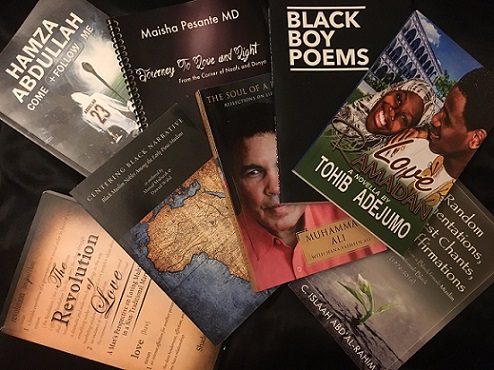
Authors and readers met Saturday, February 22 in Hartford, CT for the second Black Muslim Reads, highlighting literary expressions of Black Muslims, a unique and dynamic American Muslim subgroup.

Sponsored by NbA Muslims and Muslim Girls Read, the event offered poets, writers, and authors of a range of books the opportunity to share their words with a captivated audience.
Ustadh Saajid opened with Qur’an recitation and outlined the Islamic significance of writing and writers.
“Allah says in the Qur’an, “Allamahu Al-Bayan [4-55].” Allah taught man the ability to express himself. There are many ways to express [yourself], writing being one of them. It serves as a reminder. When we write things, we report things, and it makes easy for us to refer to those things to remind us.
“Just as we refer to the Qur’an and Hadith, [we] can also refer to other information—poetry, storytelling and things of that nature—which are very important for the Muslims.
“It’s not saying that the Qur’an and Sunnah aren’t enough for you. Sometimes people want to look at others [who] may have been in similar circumstances. They want to know other people’s stories and how they were successful or how they made it or what advice they give to succeed in life.”
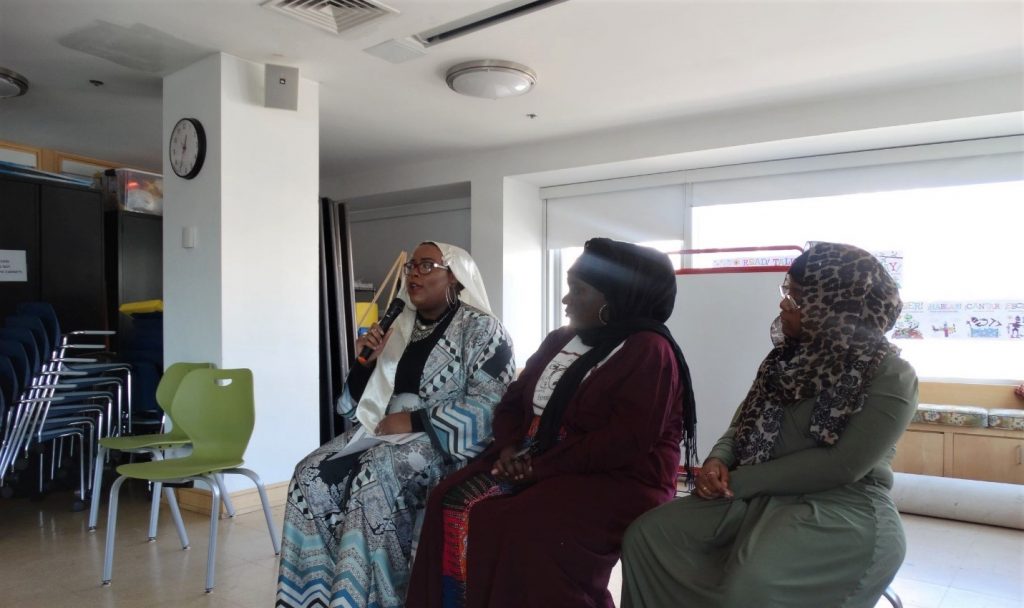
Building Narratives
A panel of young Muslim writers served on the panel to discuss building narratives, audience and honoring cultural experiences and modes of expression. As Muslim authorship and readers grow, writers must decide about tensions between their art and audience.
With such an emphasis put on dawah in Muslim culture, writers also talked about their motivations in reaching people outside of their experiences and changing the world.
“I write, and I think I try to change my own conversations first and the discourse that happens in my communities,” said Haddiyah Ali.
“I do hope writing has an impact on people around me, but often my writing starts with me grappling with my own emotions about a subject and then reaching out to people around me.”
Nzima Hutchings talked about writing to bring attention to issues.
“You are putting out things that could potentially move one’s mental furniture pieces. So, [sometimes] I am purposeful and intentional in my writing. I have a few pieces that I have written because I wanted to highlight certain areas about our [Muslim] life, our names, our clothing [and] polygyny—different topics that people question Muslims about—with the hope that I move things around a bit. So that way, others will have the opportunity to think, be open and not so closed-minded.”
“I write to put myself in stories that I would have liked to see myself in,” said Juwayriyah Ayed. “That’s usually where I get my ideas from—based on things that I love—placing myself in those stories. What would that be like? What would that look like?”
The panel also discussed challenges Black Muslim writers face in sharing their narratives and tensions across social intersections with their expressions.
“Oftentimes, we have to justify even telling our stories to somebody—to an editor or potential readers—even to ourselves at times,” said Ali.
“When I am writing, I am writing from who I am, I can’t write from someone else,” said Hutchings.
“I don’t think about audience at all,” said Ayed. “I think when I’m writing, I am writing for me and I don’t think about a grand audience. It just doesn’t cross my mind. Generally, I don’t think it hits me until I see the effect until I see the audience. I think that comes at the very end after the story has been published.”
Click for more…
The post Black Muslim Authors Hold Second Annual Conference appeared first on About Islam.
source https://aboutislam.net/muslim-issues/n-america/black-muslim-authors-hold-second-annual-conference/


Comments
Post a Comment