The Night Journey: Sometimes it Causes Me to Tremble
OK, folks, try this one at two o’clock in the morning or, if you can’t manage that, after the Fajr (Dawn) Prayer when the world around you is quiet.
Spend some time reflecting on the Night Journey and Ascension—Israa’ and Mi`raj—which takes place on 27 Rajab. Imagine yourself accompanying the Prophet Muhammad on that miraculous Night Journey.

Here’s a guy (peace be upon him) who’s been struggling for 12 long years to get people to worship only the One God, Allah. They call him “Al-Ameen”, The Trustworthy, and even the staunchest pagans continue to entrust their property to him when they travel because of his honesty. Yet they won’t accept his words concerning Allah.
Muhammad (peace be upon him) sees his followers persecuted and tortured and is powerless to help them. He himself is persecuted and reviled by most. He has recently traveled to a distant city, Ta’if, to try to win the people there to Islam, but he was ignominiously driven out. His mission as a Prophet has not brought him wealth or power.
Imagine the Scene
So here he is asleep, an ordinary human with an extraordinary mission. Imagine if you can, the Angel Jibreel (Gabriel) coming to wake him up and setting him on the marvelous steed, Al-Buraq.
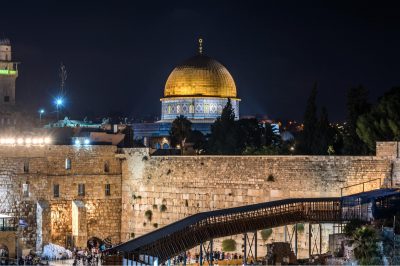
Imagine the flight to Jerusalem and the salah (ritual Prayer) of all the past prophets with Muhammad as their imam (peace and blessings on them all).
In this miraculous gathering of these holy men, they didn’t go around shaking hands and slapping each other on the back.
“Hey, Moses! I always wanted to meet you! I’ve heard so much about you!”
“Jesus! What really happened when they tried to arrest you?”
If it had been me, that’s what I would have done. But Muhammad (peace and blessings be upon him) didn’t do that, he didn’t try to gain moral strength and encouragement from his fellow Prophets, and they didn’t offer any. Instead, they all turned their attention to their Lord and worshiped Him in the way He had instructed.
Prophet Muhammad sought moral and spiritual strength not from other humans—even if they were great ones who miraculously appeared to him then—but from his Lord and Creator.
Flying with My Spirit towards My Creator
And then their flight to the heavens. It’s hard to picture it because, of course, it’s totally out of our comprehension. How can a human being—with all his physical limits, his composition of matter—how can he possibly travel in the Unseen? That’s the whole wonder and glory of it. That a human could be lifted to another realm of existence and return safe.
Dwell upon that for a few minutes while the world around you sleeps. Let your spirit be lifted up towards your Creator and Lord.
The Veil of Light
I imagine Muhammad (peace be upon him) at the highest point of his ascension, when he has reached the vicinity of the Throne of Allah. But even for Prophet Muhammad, who has already passed through so much on that night, the vision is limited.
Allah is veiled by light and Muhammad (peace and blessings be upon him) is unable to see Him. I contemplate that. I imagine that I’m standing behind Muhammad (peace and blessings be upon him) and also gazing at the veil of light. And I long to have the veil lifted. I long to gaze in adoration at my Lord.
But not yet. I’m still limited by my humanity, my corporeal being.
In a Hadith, the Prophet Muhammad told us that the believers will have ocular vision of their Lord in the hereafter. Will we only be able to glance because even in our resurrected bodies the sight will be too much for us? Or will we be able to feast our eyes and gaze lovingly, adoringly? I hope the latter.
For now, when the world is quiet, I can only imagine myself before a veil of light, longing for what is within. And when I recall that Prophet Muhammad actually was in the presence of that veil of light, the tune of a gospel song comes to mind (I long ago changed the words):
Were you there when the Prophet made Mi’raj?
Were you there when the Prophet made Mi’raj?
O-o-o-oh! Sometimes it causes me to tremble, tremble, tremble.
Were you there when the Prophet made Mi’raj?
Conclusion
The world is waking up around me as I write and my own spiritual “flight” must end as I am brought back to the daily realities: breakfast to make, family to wake up, bus to catch, etc.
But those few minutes of quiet contemplation have fed my spirit and (at least for a few days) when life gets stressful, I will close my eyes and imagine myself again standing behind Muhammad in the vicinity of the Throne of the One Being Whom I long to see.
And I will tremble again at the thought that he was really there.
(From Discovering Islam’s archive)
The post The Night Journey: Sometimes it Causes Me to Tremble appeared first on About Islam.
source https://aboutislam.net/spirituality/the-night-journey-sometimes-it-causes-me-to-tremble/


Comments
Post a Comment