Remembering the First Muslims in Canada
It is unknown when Muslims first arrived and settled in the space that is now called Canada.
However, it certainly didn’t happen as recently as it is often believed.
Even the evidence we have suggests that Muslims have been making Canada their home since 1851, more than a decade before the country itself was created.

However, some historians have speculated that Mandingo (West African) Muslims’ contact with the Indigenous peoples of the Americas could predate even the arrival of Christopher Columbus in 1492.
Slave Trade
Some go a step further and give life to the possibility that these pre-1492 Muslims in North America may have sailed from the Gulf of Mexico all the way up the Mississippi River to the southern reaches of today’s Manitoba and Saskatchewan.
However, for the time being, this remains speculation, with little to no documentary evidence to support it.
There’s more evidence for the suggestion that some of the African Muslims brought to the Americas in the slave trade may have been enslaved in Canada or, after the abolition of slavery in the British Empire (including Canada) in 1833.
They tried to obtain freedom by escaping to Canada using the famous Underground Railroad.
Mahommah Baquaqua
Slavery in Canada, though it certainly did exist, hasn’t received much scholarly attention, so there isn’t too much to draw on there.
With regards to African Muslims seeking freedom in or through Canada, Mahommah Baquaqua can be cited as an example.
Born into a devout Muslim family in West Africa, Mahommah (i.e., Muhammad) was enslaved as a young man in Brazil.

From there, he was shipped to the United States, where a remarkable turn of events earned him his freedom.
Eventually, he settled for a while in Chatam, a small town in Ontario, and it was here that he wrote the autobiography that made him famous.
In 1854, the year that Baquaqua arrived in Canada, three Muslims (or “Mahomadens”, as the census called them) were already living there.
They were a young couple, James and Agnes Love, who had emigrated from Scotland in 1851 to become the first recorded Muslims in Canada.
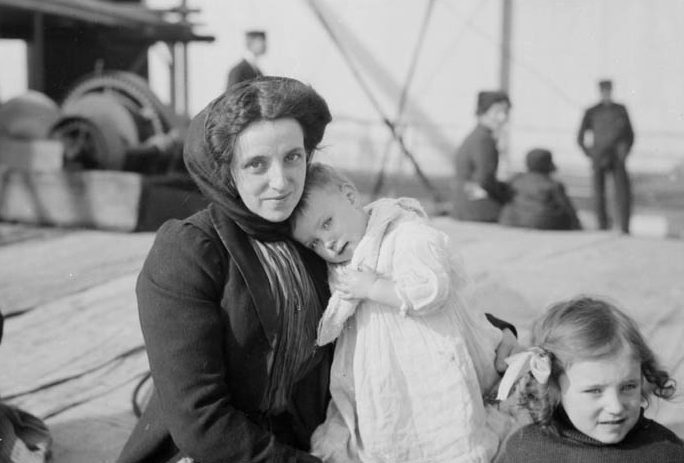
James and Agnes
This is interesting because it is commonly believed that the first known Muslim in Scotland was Wazir Bēg, a medical student from India who studied at the University of Edinburgh in 1858 and 1859.
But this doesn’t necessarily discredit the faith of the young Muslims who set out for Canada several years earlier, because Islam was not unknown in the United Kingdom.
Whatever the case may be, James and Agnes arrived in southern Ontario in 1851 and settled there. Three years later, Agnes gave birth to a child who was named after his father―the first known Canadian-born Muslim.
The couple would go on to have seven more children, including the youngest, Alexander, who was born in 1868, a year after Canada was established.
John and Martha Simon
Another family of Muslims arrived in southern Ontario in 1871.
These were another young couple, John and Martha Simon, both of whom were apparently born in the United States but were the children of immigrants from Europe.
They may very well have been from Eastern Europe, large parts of which were still ruled by the Ottoman Empire at the time.
The arrival of John, Martha, and their children―in addition to the Love family―brought the total number of Muslims recorded in Canada’s 1871 census to 13.
Of course, carrying out the census was a very complex and difficult task in the late 19th century, and it is possible that there were many more Muslims who were not recorded.
Three decades later (and half a century after James and Agnes arrived), the 1901 census recorded 47 Muslims in Canada, though it is unknown how many of them (if any) were descendants of the Love or Simon families.
At least a handful were recent immigrants from Ottoman-ruled Lebanon and Syria, most of whom were settling in Alberta.
Some of them had reportedly taken part in some of the key events in Canadian history, such as the Klondike Gold Rush and the building of the Canada Pacific Railway.
Many more, such as Ali Abouchadi, were on their way.
As of 2017 and Canada’s 150th anniversary, Muslims have been making Canada their home for at least 166 years.
Sources: Daood H. Hamdani, “Muslims in the Canadian Mosaic”, Institute of Muslim Minority Affairs Journal 5, no. 1 (1984): 7-16.
***
This article is from the archive. It was originally published at ihistory.co
The post Remembering the First Muslims in Canada appeared first on About Islam.
source https://aboutislam.net/family-life/culture/remembering-first-muslims-canada/


Comments
Post a Comment