Qur’an Recitation: Lightning Sparks for Your Brain
Throughout history, many civilizations have made significant progress in the world of science and various other fields through the proper employment of their brains. However, the Islamic civilization surpassed them in achieving superbly remarkable progress using both materialism and idealism.
A non-Muslim professor, in a 4th year undergraduate class on the history of science, once said, “If it wasn’t for their political problems and constant fighting between each other, the Muslims would have been on the moon by the 1400’s”.
Did Muslims excel at science because they harbored what others lacked? Searching inside the Islamic civilization’s educational system will lead you to the Holy Qur’an. The education system of the ancient Islamic civilization was centered on the memorization, recitation and comprehension of the Holy Qur’an.
 Read Also: I Thought It Was Cool Arabic Pop Music; It Was the Quran
So, how does reading the Book of Allah have such an everlasting impact on the functioning of the most complex organ of the human body? The answer lies in the various components of the brain that are stimulated and activated when the verses from the Qur’an are being recited.
The process of reading the Holy Qur’an is analogous to an athlete in training for a marathon. When in preparation for a marathon, an athlete prepares by running long distances, consuming a healthy diet, eventually developing endurance, and habituating the muscles.
Likewise, memorization of the Holy Qur’an has the same effect on the brain of an individual. The continuous recital of the verses with the proper elocution (Tajweed) leads to the activation of certain areas of the brain which ease the act of comprehension, processing and retention under all capacities.
Read Also: The Power of the Quran in Changing Hearts and Minds
-
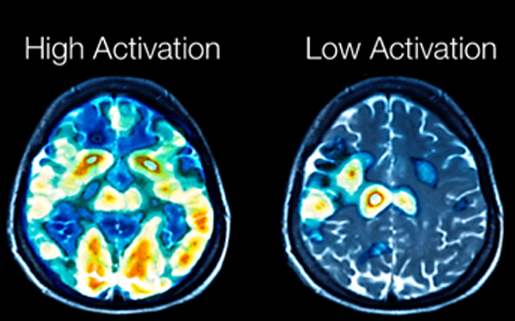
The Cerebral Cortex is the largest part of the human brain, associated with higher brain function such as thought and action.
Brain Activity

There isn’t only a spiritual reality to the memorization and the recitation of the Qur’an, but rather a materialistic reality which takes shape in the brain.
The main parts of the brain which are activated from the recitation of the Holy Qur’an are the three lobes of the Cerebral Cortex; the Frontal Lobe, the Parietal Lobe, and the Temporal Lobe.
The Cerebral Cortex is the largest part of the human brain, associated with higher brain function such as thought and action. The act of listening to the Qur’an and pronouncing it accurately during memorization leads to the stimulation of the Temporal Lobes, which contains the Hippocampus which is the memory center of the brain.
The activation of this region on a consistent basis through the memorization of the Qur’an, which was done on a daily routine until over 6,000 of the Qur’anic Ayahs were memorized, leads to increased memory retention.
Likewise, the left and the right parietal lobes, which process reading, writing, speech, logic visuospatial relationships and understanding of the facial expression, are also consistently stimulated leading to improved logic and mathematical skills and stronger visuospatial skills; and this can explain the success of the Muslim civilization in astronomy and mathematics.
The Muslim civilization was home to the world’s top polymaths such as Al-Kindi, and Al-Khwarizmi.
As listening to the Holy Qur’an is equivalent to listening to music, recent studies indicate that this leads to the release of dopamine, a neurotransmitter—a chemical released by neurons (nerve cells) to send signals to other nerve cells.
Dopamine plays a major role in reward-motivated behavior. This also leads to pain reduction and helps individuals recover from stroke or other injuries. It also aids in the betterment of cognitive skills as well as improving endurance and dementia symptoms.
The education system of the Muslims did serve as a cornerstone in the rise of the civilization. Having the education centered on understanding Holy Qur’an not only uplifted their spirituality, but also improved their mental capabilities, enabling success in the fields of science, technology, medicine, astronomy, mathematics and many more.
Careful surveillance of education worldwide shows that hardly any education system around the world follows a similar structure.
In order to reach full potentials as Muslims and in order to relive the legacy of the early Islamic civilization, an education system which is traditional and technological simultaneously in accordance with today’s day and time can aid in achieving great heights.
Learning is both a process and an outcome, and the best way to succeed is to follow in the footsteps of those who have left an unprecedented mark.
This article is from our archive, originally published on an earlier date and highlighted here for its importance.
References:
- The Islamic Post | Online Edition. (n.d.). Retrieved May 16, 2016, from http://www.islamicpostonline.com/health/2013/06/18/brain_research_quranic_memorization_key_muslim_scientific_discoveries-545/
- This Is Your Brain On Music. (2014). Retrieved May 16, 2016, from http://www.medicaldaily.com/your-brain-music-how-our-brains-process-melodies-pull-our-heartstrings-271007
The post Qur’an Recitation: Lightning Sparks for Your Brain appeared first on About Islam.
source https://aboutislam.net/muslim-issues/science-muslim-issues/lighting-sparks-brain-quran-recitation/


Comments
Post a Comment