3 Questions About the Night Journey
The Night Journey was one of the major events in the life of the Prophet (peace and blessings be upon him).
It occurred during a difficult phase of the Prophet’s call in Makkah. So, it was a great and uplifting experience for the Prophet, full of blessings and great events.
Below, you can find answers for 3 important questions about this special journey.
 Watch Also: Heavens Have a Kabah Too
When did the Night Journey take place?
The exact date of this great event is still controversial:
- Some scholars, including Imam At-Tabari, are of the opinion that the Night Journey occurred in the same year the Prophet (peace and blessings be upon him) received the first revelation.
- Imams An-Nawawi and Al-Qurtubi prefer the opinion that it occurred five years after the Prophet’s mission.
- Another opinion sets Rajab 27, 10 years after the Prophet embarked on his great mission as the exact date of the event.
- Still, other scholars are in favor of dates ranging from 12 to 16 months prior to the Prophet’s migration to Madinah.
The first three opinions were rejected by some scholars on the basis that it is established that the obligatory Prayer was instituted on the night of Al-Israa’ and that such institution had not occurred during the lifetime of Khadijah, the Prophet’s wife, who passed away in Ramadan, 10 years after the Prophet had started his noble mission.
As for the other opinion, I [Mubarakpuri] did not find any proof to strengthen it. However, the context of Surat Al-Israa’ implies that it was revealed in a late time during the Makkah phase.
What happened during the Journey?
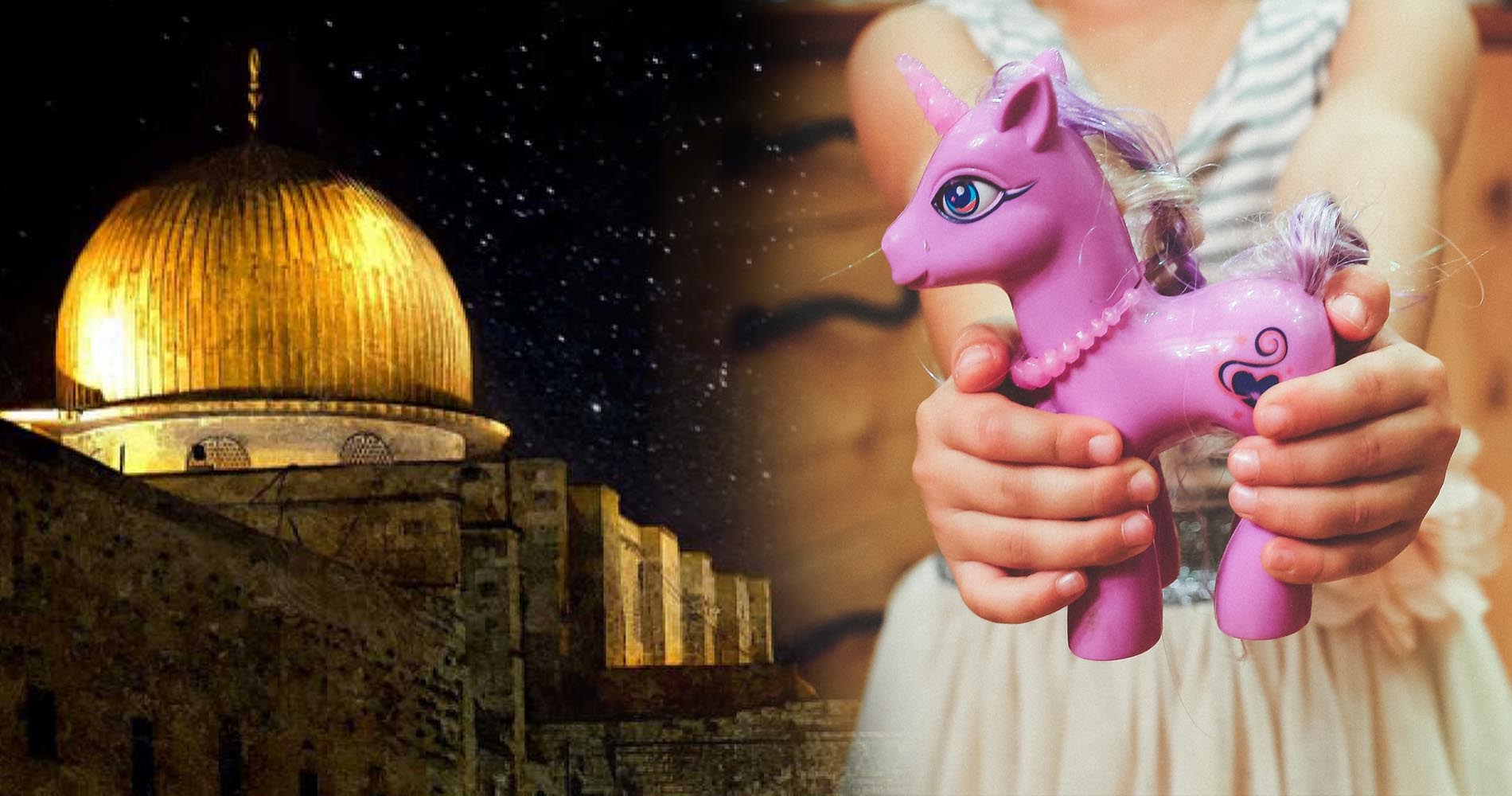
The scholars of Hadith reported the details of the Night of Al-Israa’. Here is a summary of the Night’s events:
The Prophet (peace and blessings be upon him) was carried in body from the Sacred Mosque in Makkah to the Al-Aqsa Mosque in Jerusalem on a mount called Al-Buraq in the company of Angel Gabriel. There, Prophet Muhammad led all the other prophets in prayer.
Ascending to Heavens
After that, Gabriel took him to the heavens. When they reached the first heaven Gabriel asked the guardian angel to open the first heaven’s door.
Watch Also: Night Journey: What Was the Prophet’s Means of Transport?
It was opened and Prophet Muhammad saw Adam (peace be upon him), the progenitor of humankind. The Prophet saluted him.
Adam welcomed the Prophet and expressed his faith in Muhammad’s prophethood. The Prophet saw on the right side of Adam the souls of those who will be happy in the hereafter and saw the souls of the doomed ones on his left.
Gabriel then ascended with the Prophet (PBUH) to the second heaven and asked for opening the gate. There, the Prophet saw and saluted Prophets Yahya (John) and `Isa (Jesus), peace be upon them. They returned the salutation, welcomed him, and expressed their faith in his prophethood.
The same happened in each heaven:
In the third heaven, the Prophet saw Prophet Yusuf (Joseph);
he saw Prophet Idris (Enoch) in the forth heaven;
in the fifth, Prophet Harun (Aaron);
in the sixth, Prophet Musa (Moses);
and in the seventh, Prophet Ibrahim (Abraham), ( peace and blessings be upon them all).
When Prophet Muhammad left Prophet Musa in the sixth heaven, Prophet Musa began to weep. Asked about the reason, he answered that though Muhammad was sent after him as a messenger, those who will enter Paradise from Muhammad’s nation are greater in number than those from Musa’s nation.
The Prophet then was carried to Sidrat Al-Muntaha (Arabic for “the remotest Lote-tree”).
He also was shown Al-Bait Al-Ma`mur (Arabic for “the much-frequented house”) which is attended daily by 70,000 angels; the angels who attend it never leave it until the Day of Resurrection.
50 Prayers
He was then presented to the Divine Presence getting at the closest possible nearness. There, Almighty Allah ordained 50 daily prayers for him.
On his way back, he told Prophet Musa that his followers had been commanded to pray 50 times a day. Prophet Musa advised him to ask Allah to reduce the number because the Muslim Ummah would not bear performing such a number of prayers.
The Prophet turned to Gabriel as if asking his counsel. Gabriel nodded, “Yes, if you desire,” and ascended with him to Almighty Allah.
Then Almighty Allah made a reduction of 10 prayers. The Prophet then descended and reported that to Musa, who again urged him to request a further reduction.
The Prophet once more begged Allah to reduce the number further. He went again and again to Almighty Allah at the suggestion of Musa till the prayers were reduced to five only. Again, Musa asked him to implore for more reduction, but the Prophet said,
“I feel embarrassed (of repeatedly asking my Lord to reduce the number of daily prayers.) I accept and resign to His Will.”
When the Prophet went farther, a caller was heard saying: “I have imposed My (Allah’s) ordinance and alleviated the burden of My servants.“
How did people react to the news?
The Night Journey raised a good deal of stir among people, and the skeptical audience plied Muhammad with all sorts of questions. The disbelievers found it a suitable opportunity to jeer at the Muslims and their creed.

They pestered the Prophet with questions as to the description of the Mosque at Jerusalem, where he had never gone before, and to their astonishment, the Prophet’s replies furnished the most accurate information about it.
However, they accepted nothing and persisted in disbelief.
For true Muslims, however, there was nothing unusual about the Night Journey. Almighty Allah, Who is powerful enough to have created the heavens and the earth, is surely powerful enough to take His Messenger beyond the heavens and show him firsthand those signs of His that are inaccessible to people otherwise.
This believing attitude was epitomized by Abu Bakr (may Allah be pleased with him) whom the disbelievers challenged on account of this event to believe what the Prophet said. He readily responded, “Yes, I do believe in it.”
It is reported that this answer is what earned him the famous title of As-Siddiq (Arabic for “the verifier of the truth”).
References
Abridged and adapted from the author’s The Sealed Nectar.
The post 3 Questions About the Night Journey appeared first on About Islam.
source https://aboutislam.net/shariah/prophet-muhammad/his-life/3-questions-night-journey/


Comments
Post a Comment