This Ramadan, Let Your Family Heal with the Qur’an
“Progress is impossible without change, and those who cannot change their minds cannot change anything.” ~George Bernard Shaw
How many times have you promised yourself to change for the better? How many ambitious plans have you made and then failed to achieve?
Every year Ramadan comes with its blessings and we promise that this time it would be better, yet here we are again, it’s a vicious cycle.

This Ramadan, make it happen. Make it a family project to bring about change. Allah calls the Qur’an Al-shifa (the healer). This is exactly what we need to do. We need to heal our souls. Dust off the covers of not only the Qur’an, but also the interpretations of the Qur’an.
As Allah (swt) says in Surah Fussilat: 46,
“whosoever does good deeds, it is for (the benefit of) his own self; and whosoever does evil it is against his own self. And your Lord is not at all unjust to (His) slaves.”
Get closer to His commands, get closer to His mercy and connect your families into pleasing and worshiping the sole creator.
Start with yourself
One of the best ways to learn what Allah (swt) wants from us is through the glorious book which He revealed, Al-Qur’an. Each time we open the Qur’an, it is as if there are many things that are still unfamiliar to us. There is always a new lesson we walk away with.
First, invoke Allah to give us Barakah in our time and then embark on this journey of connecting with the Qur’an as a family.
Don’t wait for your parents, your spouse, your friend, or anyone else; you be the first one to start a family halaqa. Be among the sabiqoon (those who begin and make the initiative) that Allah mentions of in the Qur’an. You be the goal setter. Allah (swt) loves those who seek to please Him.
Al-Bukhari narrated in a beautiful hadeeth, that Abu Huraira said: the messenger of Allah (S) said, “Allah (swt) says,
“My slave does not draw closer to Me by anything more beloved to Me than that which I have made obligatory upon him, and My slave continues to draw closer to Me by doing nafil deeds (Voluntary worship) until I love him, and if I love him I will be his hearing with which he hears, his vision with which he sees, his hand with which he strikes and his feet with which he walks. If he were to ask of Me, I would surely give it to him; if he were to seek refuge with Me, I would surely grant him refuge.”
What can be more beautiful than Allah (swt) loving you and your family!
A great way to please Allah (Swt) is to worship Him collectively as one unit with your family. Ramadan is a perfect time to start and reboot our iman.
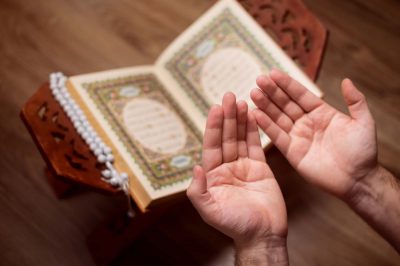
Collective worship
Take time out of your busy schedule, slow down and make goals prior to Ramadan, so that you are ready in Ramadan. Prepare your Ramadan days as you would prepare yourselves for meeting with a higher authority. Make the family aware of the project you are about to start.
One of the numerous ways to connect with the Qur’an is to start a family meeting with all the family members present. For instance, your spouse arrives from work at around asr time. Wait for him/her then pray salah as a jama’.
Sit down with your family in a circle, it’s easier to make eye contact and address each of them this way. Begin with talking about your day, then pick an ayah from the Qur’an, it’s easier if you go in order as to bookmark it for the next time.
Each of the members seated in the circle has to recite it, with proper tajweed if possible, then, don’t stop there. Open a book of tafseer (interpretation), such as Ibn Katheer and read the interpretations of it.
Discuss with each other in what manner to implement what was just learned. If you have older kids, you can make it a bit more challenging by trying to memorize a surah of the Qur’an as a family. Get creative and come up with projects that will benefit each member of the family.

What about kids?
Most of us are running low on Islamic books, now would be a good time to stock up. Especially for children. At bedtime read them stories that are connected to the Qur’an, there is a plethora of them available in stores and online.
There are numerous lessons that are mentioned in the Qur’an in the form of stories. Allah has given us those stories to reflect upon. However, it’s a challenge for caregivers to teach those lessons to young children.
One beneficial way for kids to learn and implement lessons from the Qur’an is through creating with their hands.
You can make a treasure box with the kids in which they get to pick any story from the Qur’an. Then prepare crafts together about it. For instance, the Qur’an mentions the story of Prophet Noah. Get construction paper and build an ark with the kids. Make this time a special one that your family will cherish for years.
The Qur’an addresses each and every human being at a personal level. It touches the soul with inspiring words and uplifting meanings. We need to first and foremost be aware of what Allah (swt) is telling us and guiding us towards.
We are the building blocks that are working on the structure of the family. Construct your family by implementing the teachings of Qur’an in your daily lives. Share that joy, that indescribable feeling with your families.
Allah (swt) says in the Qur’an, surah Al-Isra: 82,
“and We send down of the Qur’an that which is a healing and a mercy to those who believe.” This Ramadan get closer to Allah (swt) and heal yourself and your families.
First published: June 2016
The post This Ramadan, Let Your Family Heal with the Qur’an appeared first on About Islam.
source https://aboutislam.net/family-life/moms-dads/this-ramadan-let-your-family-heal-with-the-quran/


Comments
Post a Comment