5 Strategies to Improve Self Confidence
What is Self Confidence?

As we know, self-esteem refers to whether or not we value and appreciate ourselves. Self confidence, on the other hand, refers to how we feel about ourselves and our abilities.
There is a subtle difference between the two. In some cases they overlap and help maintain each other but at other times it is possibly to act in a highly confident manner while having profoundly low self-esteem. It is also possible to generally have high self-esteem but feel very under confident in some circumstances.
Our level of confidence can change from one situation to another. It is not unusual to feel confident in familiar circumstances and less so when confronted by new challenges. Our self confidence can also be influenced by past events and our memories.
Young adulthood is often fraught with internal battles; often between what we want to do and what we think we can do. A self-confident person is ready and eager to rise to new challenges. They seize opportunities and are also able to take responsibility when things do not go as planned. If a person is fortunate and has grown up in favorable conditions they are likely to have high self-esteem and self-confidence.
However, if a person has been impacted in negative ways they may have internalized some negative feelings about themselves and that can easily become part of how they view themselves.
The impact of low self-confidence can actually be quite debilitating and can result in, extreme shyness, communication difficulties and social anxiety.
Self-confidence is something that needs to be maintained. It can wax and wane and it is our own responsibility to keep it at a healthy level.
Most young Muslims would already understand that faith is something that can wax and wane. Some days we are up and eager to pray, other days we might not relish the thought of early rising. Some days we might feel that we can accomplish anything while on others we might want to stay on the couch all day.
There are numerous strategies that can help boost self-confidence, and when practiced diligently these strategies can help you stand upright and face your daily challenges.
Five Strategies to Improve Self Confidence

1- Manage Your Expectations
Make sure that your goals are things you can realistically achieve. Do not set yourself up for failure. For instance you can’t run a marathon without training for several weeks or months.
If you are currently not doing well at school you can’t expect to get an A tomorrow, but you can expect to get one after you have increased your study and taken steps to make your goal a reality.
2- There is No Such Thing as Failure
There are only steps that lead to the ultimate success. Islam tells us that the ultimate success is Paradise and that everything that happens on the way is only a step on the path.
And my success cannot come from any source besides God. I have put my trust in Him. (Quran 11:88)
Therefore in whatever you do, aim to please God and trust that He will guide your steps. In your daily life, you cannot fail; you can only learn from your attempts and then use what you have learned to make your goal achievable.
Failure is inherent in achievement, thus in order to pursue your goals, you must accept that you will have to work hard and often face your weaknesses.
3- Embrace Uncertainty
Because all your efforts are learning experiences, you should allow yourself to take risks and make mistakes. Expect difficulties and failures and use them as stepping stones, don’t be disappointed if you don’t do it perfectly. Even the experts are struggling in some aspects of their lives. Feel good about new experiences, making progress and increasing your competence.
4- Be Prepared
Clarify your goals. Some people find it easier to have broad range goals, where would you see yourself in five years, for instance. Next, break your goals into steps along the way. Where would you want to be in a year?
Work out achievable stepping stones for each month, week, or day. Assess the skills you need and then learn them.
Once you have learned them you need to practice them. And when you have successfully taken even the smallest step in the right direction, allow yourself to feel successful; accept that you have reached a goal, and feel the satisfaction before moving on.
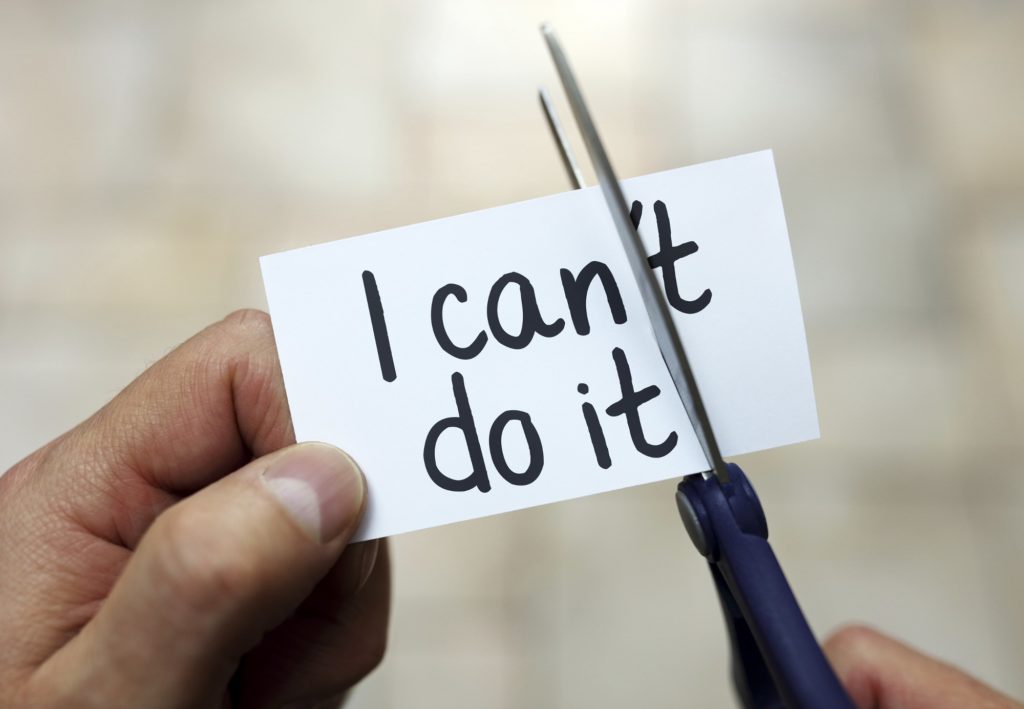
5- Do Not Engage in Negative Self-talk
If those with very little self-confidence receive a low mark on a test or assignment, they are often tempted to put themselves down, or engage in negative self-talk. ‘I am so stupid’ or ‘What else could I expect’.
However, a person with healthy level of self-esteem and self-confidence will use the low mark to change the narrative. ‘What can I do to improve on that? What did I miss?’ Often we are harsh and unjust to ourselves in a way that we would never be with our family or friends. Prophet Muhammad said:
Whoever wishes to be delivered from the fire and to enter Paradise…should treat the people as he wishes to be treated. (Muslim)
We should also treat ourselves in the way Islam tells us we should be treated.
This negative self-talk can severely impact our lives, causing stress and unhappiness whilst undermining our self-confidence.
Self-confidence affects many aspects of our lives, yet many people struggle to achieve a healthy level of self-confidence and self-esteem.
Oftentimes the things that we worry about are totally outside our control. Islam tells us to trust in God.
If you rely on Allah (SWT) as you should rely on Him, then He would provide for you as He provides for the birds; they wake up hungry in the morning and return at dusk with full stomachs. (At-Tirmidhi)
But it also tells us to be prepared, to do the ground work necessary for success. A man asked Prophet Muhammad:
“Should I tie my camel and trust in Allah, or should I leave her untied and trust in Allah?”
He replied:
Tie her and trust in Allah. (At-Tirmidhi)
Thus if you work diligently to improve yourself, you most certainly are able to achieve self-confidence and success.
(From Discovering Islam’s archive)
The post 5 Strategies to Improve Self Confidence appeared first on About Islam.
source https://aboutislam.net/reading-islam/living-islam/5-strategies-to-improve-self-confidence/


Comments
Post a Comment