Do Muslims Worship Kabah?
One of the most striking images of the COVID-19 era is the picture of Kabah with no single person around it.
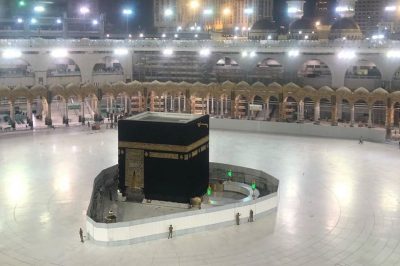
Millions of Muslims used to travel to the Holy Mosque to perform Tawaf (circumambulation) around Kabah as part of Umrah and Hajj on daily bases. Moreover, all Muslims around the world face the direction of Kabah at least 5 times a day to observe their daily prayers.
So, some non-Muslims may ask, “Do Muslims worship Kabah?”
Those who are not familiar with the tenets of the Islamic faith may mistake the rituals of prayers and Hajj for Kabah worship. They might think that Muslims are praying to the Kabah to fulfill their requests or to save them.
But that is totally wrong.
Muslims do not worship anything or anyone but Allah the Almighty.
Tawheed is the pillar of Islam
First of all, Tawheed (monotheism) is the cornerstone of Islam. Believing in One God, Allah, and worshipping Him ALONE is the first of pillar of Islam. That is the very meaning of the first part of the testimony of faith (shahadah) that anyone entering Islam MUST declare.
 Read Also: 8 Questions on Kabah & Change of Qibla
So, in Islam, there is a zero tolerance with anything that might blemish this principle. Worshipping anyone or anything with Allah Almighty is the most heinous sin in Islam. It is a major sin to pray to anyone or anything other than Allah.
Prayer towards Kabah

When Muslims face the Kabah in the prayers, they do not do so because they worship the Kabah. They don’t pray to Kabah but rather they pray towards the Kabah. They never believe that the Kabah is God or that God is within the Kabah.
Rather, they pray to Allah facing the direction of Kabah in fulfillment of Allah’s command to do so.
The prayer itself does not include any mention of the Kabah; none of its words refers to or addresses the Kabah itself. In Salah (Arabic for Prayer), Muslims praise Allah and supplicate Him alone. In this sense, praying towards the Kabah is an embodiment of full devotion and submission to Allah alone; He commanded Muslims to face the Kabah while praying and they do so.
By the way, initially Allah commanded Muslims to pray towards Jerusalem and Muslims implemented this command for some years. Later, when the Prophet received God’s command to face the Kabah in their prayers, they obeyed immediately.
Going around Kabah

The same applies to tawaf (circumambulating the Kabah during pilgrimage). No Muslim thinks of worshipping the Kabah through performing tawaf.
Like prayer, the tawaf is dedicated to praising Allah, remembering Him and asking for His blessings and favors. Kabah is the point that Allah commanded Muslims to go around while remembering Him, and supplicating him.
No Muslim entertains the idea that the Kabah can bring any benefit or remove any harm; let alone think that the Kabah has any divine attribute.
Honored Symbol of Islam
Kabah is respected as a symbol of Islam and a sacred place. However, in one hadith, Prophet Muhammad (peace and blessings be upon him) said the following about it:
“How great you are and how great your sanctity! By the One in Whose Hand is the soul of Muhammad [i.e. Allah], the sanctity of the believer is greater before Allah than your sanctity.” (Authenticated by Al-Albani)
More About Kabah:



The post Do Muslims Worship Kabah? appeared first on About Islam.
source https://aboutislam.net/shariah/special-coverage-shariah/hajj-and-umrah/muslims-worship-kabah/


Comments
Post a Comment