This Ramadan, Make Your Home the Masjid
Recently, my phone has been flooded with images of corners of people’s homes decorated with prayer mats, prayer beads and Ramadan-themed art. This was in response to a challenge to create a mihrab or space of worship in your home for Ramadan.
The bright-colored prayer mats gave me an even brighter smile. They gave me hope that coping during a quarantined Ramadan is possible.
But some of us are still struggling to make that adjustment. With the masjid closed, what can we do to allow our homes to be the stand-in masjid?
 Read Also: 15 Hadiths About Ramadan
A Home and a Masjid: The Prophet’s Story
The Seerah offers interesting insight into what it means to establish prayer in our homes. In early Islam, the Muslims of Makkah were heavily persecuted for the faith. From being beaten to forced to lay out in the burning sun with boulders on their chest, the safety of the Muslim required secrecy of congregation.
Therefore, a companion named Al-Arqam bin Abi Al-Arqam offered his home as a gathering space. Essentially, this was the first masjid that we reference as “Dar (House of) Al-Arqam.”
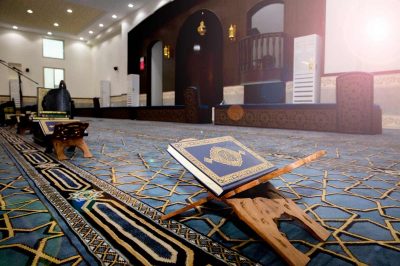
The status of Al-Arqam with Allah is immense for sacrificing his meager home for the sake of Allah. So what say we reap the reward of sacrificing our homes for the sake of Allah?
Another fact is that the Prophet’s Mosque in Madina was attached to his home (peace be upon him). In fact, the prayer space of the masjid and his bedroom were separated by a simple curtain! Within a few steps the Messenger of Allah could wake from sleep and rise to lead prayer for the Muslim community.
Many times, we view the masjid almost as this mystical segregated place of worship. This was farthest from the truth for the Prophet! Adopting the paradigm shift can be very helpful in making the most of this Ramadan.
Maryam and Musa (peace be upon them)
Maryam (peace be upon her) is regarded as one of the best women to ever exist. So did she have a community masjid to pray taraweeh in? Did she bring pots of soup or rice to the community iftar at the masjid multi-purpose room? No. What we know of Maryam is that she understood the psychology of space very well. We will discuss psychology of space in a bit.

Maryam would often disappear into a secluded area (known as a mihrab) and worship Allah in solitude. In her solitude, she would be sent fruits (that were out of season for the time) by Allah.
It is even in this seclusion that angel Jibreel would visit her to give her glad tidings of a son! What was otherwise a neutral space became elevated by Maryam’s worship! The space became so blessed it was even visited by angels! Our homes can be the resting place of angels too this month!
On the other hand, Musa (peace be upon him) had a different circumstance. His people were believers living under the torture of the oppressor, Firawn. To erect a masjid would not be safe for the believers or Musa. So, Allah instructs the following in the Quran.
{We revealed to Moses and his brother: ‘House your people in Egypt and make these houses places of worship; keep up the prayer; give good news to the believers!’} (Yunus 10:87).
Their homes became the masjid of their time!
The Psychology of Space
Environmental psychology is the study of the interaction of individuals and their environment. One interesting concept in environmental psychology is focusing on the function of a space.

For example, psychologists don’t advise studying on your bed. Your brain associates the bed with the function of sleep. So for many, studying on the bed will cause one of two subconscious reactions:
1) You’ll get sleepy because your brain recognizes the bed as a signal to sleep.
2) Or, your sleep patterns will mess up because the function of your bed is being uprooted.
So, remember the introduction about decorating corners of one’s home! It’s time to repurpose the function of your home!
Before Ramadan begins, clear out a space, rearrange furniture and create your own reflection/worship space in your home!
If you have kids, make it a project for them! You can even hang a calendar and use it to measure your progress on Ramadan goals like Quran and dhikr!
You can even create a seating area to tune into the many Islamic lectures and live recitation that will happen virtually.
Our Homes Are Sanctuaries
In Arabic, the word for home is also the word for sanctuary: sakan. It shares a root with the word for serenity, sakeena. This is no coincidence! Allah intended for our homes to be our sanctuaries and places of serenity.
The masjid also serves those two purposes. So this Ramadan, do not be discouraged. Instead, know that the potential for sakeena is already present in your home. Your job is to be intentional to bring it out through your recitation, dhikr, duaa, and prayer.
May Allah accept this Ramadan. May Allah forgive our dead who couldn’t make it to this Ramadan. It will certainly be a Ramadan we never forget.
The post This Ramadan, Make Your Home the Masjid appeared first on About Islam.
source https://aboutislam.net/shariah/special-coverage-shariah/ramadan-special-coverage-shariah/this-ramadan-make-your-home-the-masjid/


Comments
Post a Comment