5 Questions About Hajj and `Umrah
Only few weeks separate us from the annual season of Hajj. Two million Muslims will gather in Makkah this year to perform the rituals of Hajj, the fifth pillar of Islam.
Below are answers for basic questions on Hajj and `Umrah and their rituals.
1. What are Hajj and`Umrah?
Hajj and `Umrah are the pilgrimages of Islam. Hajj is usually referred to as the major pilgrimage or the Pilgrimage, and `Umrah as the lesser one.
Both Hajj and `Umrah consist of a journey to Makkah that involves certain rituals such as ihram, circumambulating the Ka`bah, walking between the hills of Safa and Marwah, and shaving or cutting the hair.
2. What are the differences between Hajj and `Umrah?
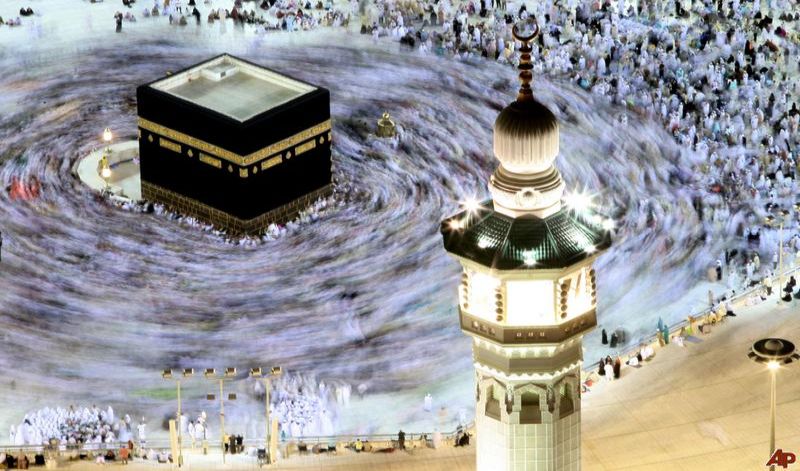
The rituals mentioned in the previous answer are the basic rituals of `Umrah while Hajj has these and additional rituals, including spending days and nights in `Arafah, Mina, and Muzdalifah – areas neighboring the city of Makkah.
Another difference between the major and minor pilgrimages is that there is a prescribed time for Hajj whereas `Umrah can be performed at any time in the year. In addition, Hajj and `Umrah differ regarding the ruling of each of them, as discussed below.
3. What is the ruling of Hajj and `Umrah?
Hajj is one of the pillars of Islam. Allah says in the Qur’an
{And pilgrimage to the House is a duty unto Allah for mankind, for him who can find a way thither} (Aal `Imran 3:97).
`Abdullah ibn `Umar (may Allah be pleased with him) quoted the Prophet (peace and blessings be upon him) as saying
“Islam has been built on five [pillars]: testifying that there is no god but Allah and that Muhammed is the Messenger of Allah, performing the prayers, paying the zakah, making the pilgrimage to the House, and fasting in Ramadan.” (Muslim)
 Read Also: How Hajj Can Be a Model for Life
So Muslim scholars are unanimously agreed that Hajj is obligatory once in a lifetime for those eligible. What makes people eligible is discussed below.
As for `Umrah, Muslim scholars disagree whether it is obligatory or merely a recommended Sunnah. However, it is better to perform it in order to be on the safe side. You can choose the mode of Hajj known as tamatu` in which both `Umrah and Hajj are performed. More information on tamatu` and the other modes of Hajj are provided later in this article.
4. Who Should perform Hajj?
Hajj is obligatory on male and female Muslims who meet the following conditions:
a. Muslim
The acts of worship are accepted only from Muslims. If non-Muslims pray, fast, or perform Hajj or `Umrah, their acts will never be accepted since the first and foremost requirement, that of being a Muslim, is absent.
b. Reaching puberty
Attaining the age of puberty is the second condition. Little boys and girls are not required to do Hajj or `Umrah. It is acceptable and rewardable to let them participate with their families in performing Hajj and `Umrah, but they are still required to do Hajj and `Umrah again when they reach the age of puberty, which can be verified by meeting one of the following criteria:
1. Having a wet dream
2. Ejaculating semen
3. Reaching the age of 15
4. Growing pubic hair
5. Menstruating
c. Sane
Insane people are not required to perform the acts of worship until they regain their sanity.
d. Having the ability
As it is clear from the above verse, Hajj is only required from those able to do it. The ability mentioned here is in terms of three things:
1. Health
People who are ill and are not expected to recover or to be able to perform Hajj in the future, or who are too old to perform Hajj are excused from Hajj. However, if they are financially able, they have to send another person to perform Hajj on their behalf.
2. Financial ability
People should also be able to afford the costs of Hajj and to leave enough money for these they are responsible for. Muslims are not required to take loans to perform Hajj or `Umrah. Actually, Hajj is not obligatory on those who are in debt.
However, if someone has a long-term loan and they are required to pay only a certain amount each month, then their debt is only that which is due each month. If they pay off all the debt and then nothing is left with them to make Hajj, then Hajj is not obligatory on them. But if they only pay their monthly dues and then have enough money to make Hajj, then they should make Hajj because it is obligatory on them.
If someone is in debt and their creditor allows them to go for Hajj, then they can perform Hajj. If someone takes a loan to perform Hajj and makes Hajj, their Hajj is valid, although they were not required to perform it and Hajj was not obligatory on them.
3. Safety
If traveling to Hajj would risk someone’s life, such as if there were a war or the like, they are not required to perform Hajj because they are unable to do so safely.
5. What are the modes of Hajj?
There are three modes of Hajj: ifrad, tamatu` and qiran:
a. Ifrad involves performing the rituals of Hajj only.
b. Tamatu` involves a complete `Umrah and a complete Hajj, each separated from the other. This means that the `Umrah is performed first in the months of Hajj and after completing it, one goes out of the state of ihram. Afterwards, on Dhul-Hijjah 8, one initiates ihram once again for performing Hajj.
c. Qiran is a combination of `Umrah and Hajj, performed with no break between them. After performing `Umrah, one remains in the state of ihram until starting the rituals of Hajj on Dhul-Hijjah 8.
The post 5 Questions About Hajj and `Umrah appeared first on About Islam.
source https://aboutislam.net/shariah/special-coverage-shariah/hajj-and-umrah/5-questions-hajj-umrah/


Comments
Post a Comment