What Was the Qur’an Copy of `Uthman?
During the time of `Uthman ibn `Affan (may Allah be pleased with him) differences in reading the Qur’an became obvious. After consultation with the Companions, `Uthman had a standard copy prepared from the suhuf of Abu Bakr that were kept with Hafsah at that time.
The following is the report in the Sahih of Al– Bukhari:
Anas bin Malik narrated :
Hudhaifah ibn Al-Yaman came to `Uthman at the time when the people of Sham and the people of Iraq were waging war to conquer Arminya and Adharbijan.
Hudhaifah was afraid of their (the people of Sham and Iraq) differences in the recitation of the Qur’an, so he said to `Uthman, ‘O Commander of the Faithful! Save this nation before they differ about the Book (Qur’an), as Jews and the Christians did before’.

So, `Uthman sent a message to Hafsah saying, ‘Send us the manuscripts of the Qur’an so that we may compile the Qur’anic materials in perfect copies and return the manuscripts to you’. Hafsah sent it to `Uthman.
`Uthman then ordered Zayd ibn Thabit, `Abdullah ibn Az-Zubair, Sa`id ibn Al-`Ass and `Abdur Rahman ibn Harith ibn Hisham to rewrite the manuscripts in perfect copies.
`Uthman said to the three Quraishi men, ‘In case you disagree with Zayd ibn Thabit on any point in the Qur’an, then write it in the dialect of Quraish as the Qur’an was revealed in their tongue’.
They did so, and when they had written many copies, `Uthman ibn `Affan returned the original manuscripts to Hafsah.
`Uthman sent to every Muslim province one copy of what they had copied, and ordered that all the other Qur’anic materials whether written in fragmentary manuscripts or whole copies, be burnt.
Zayd ibn Thabit added, ‘A verse from Surat Al-Ahzab was missed by me when we copied the Qur’an and I used to hear Allah’s Apostle reciting it. So we searched for it and found it with Khuzaimah ibn Thabit Al-Ansari’. (That verse was):
{Among the Believers are men who have been true in their covenant with Allah} (Al-Ahzab 33: 23). (Al-Bukhari)
So, the making of the Mushaf of `Uthman went through the following steps:
- Disputes had arisen among the Muslims about the correct manner of reciting the Qur’an.
- `Uthman borrowed the suhuf, which were kept with Hafsah.
- He ordered four Companions, among them Zayd ibn Thabit, to rewrite the script in perfect copies.
- Then, he sent these copies to the main centers of the Muslims to replace other materials that were in circulation.
What the Prophet left to the Muslims

The revelation, as left by the Prophet (peace and blessings of Allah be upon him), was available both orally and written on various materials. Its internal order was known to the Muslims and strictly observed by them.
Abu Bakr As-Siddiq (may Allah be pleased with him) collected these loose materials and had their contents written on to sheets (suhuf).
The Difference between Abu Bakr’s and `Uthman’s Collection
Abu Bakr As-Siddiq (may Allah be pleased with him) had made one single copy from the various verbal and written materials. This copy was later kept by `Umar ibn Al-Khattab and then by his daughter Hafsah (may Allah be pleased with both of them).
`Uthman ibn `Affan had many copies prepared from this copy and sent them to various places in the Muslim world, while the original suhuf were returned to Hafsah and remained with her until her death.
Later, Marwan ibn Al-Hakam (d. 65/684), according to a report from Ibn abi Dawud, collected it from her heirs and had it destroyed, presumably fearing it might become the cause for new disputes.
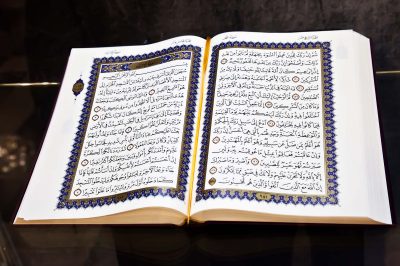
`Uthman ibn `Affan also kept one of the copies for himself. This version of the text, also known as ‘Mushaf `Uthman’ in fact constitutes the ijma` (consensus) of the sahaba, all of whom agreed that it contained what Prophet Muhammad (peace and blessings of Allah be upon him) had brought as revelation from Allah.
The wide distribution of this text and its undisputed authority can also be deduced from the reports on the battle of Siffin (A.H. 37), 27 years after the death of the Prophet (peace and blessings of Allah be upon him), and five years after `Uthman ‘s copies were distributed, Mu`awiyah’s troops fixed sheets from the Qur’an on their spears to interrupt the battle. (See Suyuti, History of the Caliphs. transl. H. S. Jarrett. Baptist Mission Press, Calcutta. 1881, p. 177.) However nobody accused anyone else of using a ‘partisan’ version of the text, which would have made a splendid accusation against the enemy.
Taken with some modifications from the Book: Ulum Al-Qur’an: An Introduction to the Sciences of the Qur’an
The post What Was the Qur’an Copy of `Uthman? appeared first on About Islam.
source https://aboutislam.net/shariah/quran/introduction-to-the-quran/what-was-the-quran-copy-of-uthman/


Comments
Post a Comment