Maryam Rolled Her Eyes at Islam: Now She’s a Muslim
“Maryam C. Lautenschlager”, the email read. I was reeling trying to figure out where I had heard that name before. Such a strange but familiar name created an echo in my mind and I couldn’t find its source.
Maryam got my email address from a friend who teaches a class on Islam for non-Muslims and new Muslims in the city.
She got in touch with me after the Islam class. She realized she lives in the same small suburb of New Orleans as me. But her name was setting off bells in my mind. So, I did what any good Xennial (somewhere between Gen X and Millennial) would do. I stalked her Facebook page.
When I typed her name into the Facebook search field, several profiles popped up. But I knew exactly which one was hers because I knew her face. I clicked on her profile and looked through more of her pics and it all started coming back to me.
At High School

Maryam and I had a class together in high school nearly 20 years ago. I heard her name every school day when the teacher took attendance.
But Maryam and I weren’t friends in high school. At that point in our lives, we were both incredibly shy and introverted (we’re still introverts). So, branching out and making new friends was far outside both of our comfort zones. Our lives paralleled but never intersected. But Allah (SWT) had a plan for us.
I told her about our shared high school class. She didn’t remember me. Then she took out the yearbook and there I was. We were both floored by the fact that we were/are so similar, and we had many of the same friends in common, but never actually met … until now … in this way.
Researching Islam
Maryam explained the reason she contacted me in the first place was because she was researching to find out about Islam and why is it so often linked with terrorism.
But when she started researching the faith that often makes headlines because of the un-Islamic action of a few, she found more than the media had ever reported on. In those first few emails, she warned me that she had literally a million questions. I didn’t believe her. But she wasn’t being hyperbolic.
Over the next two years, we met in person as often as we could, chatted through text, and emailed nearly daily. We talked about everything under the sun- fashion, feminism, food … but our conversations always came back to faith.
Maryam read about Islam ravenously. She would make tabs in her books on Islam entitled “ask Theresa” when she came across something confusing. Analytical could very well have been a word invented just to describe Maryam. She researched Islam with a passion. But always kept a safe, emotional distance from the faith.
Maryam says:
“I was combative with Theresa for a while and rolled my eyes at her descriptions of Islam”.
Fasting Ramadan

But at the same time Maryam felt as if she had been searching her whole life. She says that “no faith ever clicked”.
That was until Ramadan of this year, when Maryam decided to give fasting a sincere effort during the holy month. She wrote the following after her first fast:
“A year or so ago, I expressed frustration to a Muslim convert friend about what seemed to be a litany of nitpicky, annoying rules in Islam […] She told me, ‘If you get to where you accept Allah in your heart and fully submit to Him, you will WANT to do these things to please Him and show your love and gratitude to Him.’
I rolled my eyes at the time. A month ago, she told me fasting for Ramadan the first year after converting was one of the most spiritually rewarding experiences she ever had. I didn’t totally roll my eyes but I wondered, ‘Why does Allah expect this from us? Why is He making us do it? Does He WANT us to be miserable?’
Inner Peace
[Then I decided to try it out and I] discover[ed] an inner peace I don’t remember ever feeling, and there it was: I WANTED to observe Ramadan, for Allah’s sake. I WANTED to please Him and do at least this one thing to serve Him. I wasn’t rolling my eyes anymore.”
Before converting, Maryam surrendered her will to Allah (SWT) during Ramadan and it changed her life. She walked towards Allah and He came to her running. She confided in me that she not only had a feeling of peace in Ramadan, she felt hopeful, something she hadn’t felt in a long time and believed she would never feel again.
Maryam took the Shahadah and became Muslim a short time after her first Ramadan. She says, “There were too many coincidences. It all made me realize Allah was holding my hand and guiding me […] It felt like the logical conclusion – IMO, the Abrahamic faiths are on a spectrum and Islam is the continuation of the Christian faith”.
Wise Tips
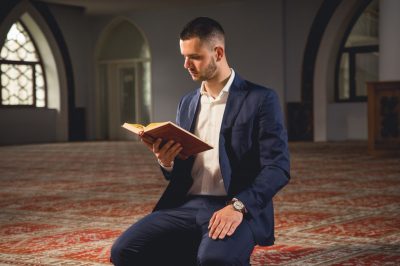
But Maryam also has some sage advice for fellow new Muslims that she has learned along her journey:
1- Be patient with yourself. You won’t learn it all in one go. Do what you can. Allah knows what’s in your heart.
2- Just because one Muslim tells you the rule is “X”, doesn’t necessarily mean s/he is correct. Ask questions. Read up on it yourself. Take your studies into your own hands. Take control!
3- Allah is perfect. Islam is perfect. Muslims are NOT perfect.
4- The prayers are prescribed for a reason. I rarely feel as close to Allah as when I’m praying, especially when my forehead touches the ground.
Since converting, Maryam is dealing with feelings of isolation, alienation, frustration from being constantly Islamsplained, and a justified fear that her family will disown her. But she says that she knows she has made the right choice.
(From Discovering Islam archives)
The post Maryam Rolled Her Eyes at Islam: Now She’s a Muslim appeared first on About Islam.
source https://aboutislam.net/reading-islam/my-journey-to-islam/maryam-rolled-her-eyes-at-islam-now-shes-a-muslim/


Comments
Post a Comment