Interpreting the Quran Through the Quran Itself
{Allah has sent down the best statement: a consistent Book wherein is reiteration. The skins shiver therefrom of those who fear their Lord; then their skins and their hearts relax at the remembrance of Allah…} (Az-Zumar 39:23)
The Quran is a book of light and remembrance, and it was revealed for us to ponder upon it and follow its guidance.
As the wellspring of Islamic teachings and primary source for Muslim belief, law, spirituality and ethics, it is crucial to ensure that it is explained according to properly conceived rules and norms of interpretation.
One of the methods which cannot be ignored is to consider the internal relations between verses of the Book.
Background
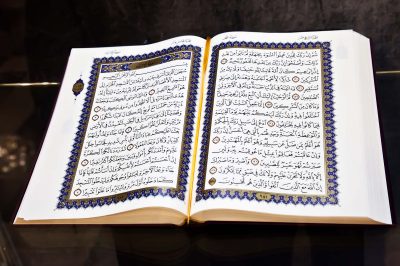
The verse quoted above highlights two special features of the Quran: its internal consistency (mutashabih) and the reiteration of its meanings throughout (mathani). Just as the Quran presents the universe as a ‘book’ for study, so the Quran itself is a ‘universe’ for exploration.
As the verses were revealed to the Prophet Muhammad (peace and blessings be upon him) over a period of more than twenty years, they fell into their pre-determined places to form one cohesive message which admits no conflict or contradiction. Instead, some verses make explicit references to others, or implicitly complete or shape their meanings.
This is why comparing verses with others in the Quran – exploring immediate and wider context – has been recognised as an essential method of interpretation since the earliest times. Hence tafsir al-Quran bi-l-Quran (explaining the Quran through the Quran), can be found in the oldest works of exegesis alongside other styles and approaches.
The Prophetic Method
Indeed, some scholars have described this as “the Prophetic method”, based on the hadith reports in which Prophet Muhammad (peace and blessings be upon him) explained certain verses in light of others. For instance, two authentic reports pertain to verses of Surat al-An`am.
The most famous is that when a verse was revealed which stated that the only people who are safe are those who {…do not mix their belief with wrongdoing (zulm)} (Al-An`am 6:82), the Companions were distressed, taking it to mean that their every misdeed would disqualify them from salvation.
However, as the Prophet (peace and blessings be upon him) explained, the “wrong” intended in this verse is to ascribe partners to God (shirk), and he directed them to the verse of Surat Luqman: {…To ascribe partners (unto Him) is a tremendous wrong} (Luqman 31:13).
That being said, it would be a mistake to suggest that this was the only way in which the Prophet (peace and blessings be upon him) explained the Quran.

The principle of “parts of the Quran clarifying others” was stated and applied by a number of early authorities, but the first explicit account of this method is found with Ibn Taymiyyah (d. 728 AH) in his Muqaddima fi Usul al-Tafsir. Later scholars approved of his statement that this is “the best method of exegesis”, to the extent that it was said to be a matter of consensus.
In terms of practice, however, there were not many exegetes (mufassirun) who gave this method prominence in their books. Although there are predecessors, it is arguably Ibn Kathir – a student of Ibn Taymiyyah – who first applied it on a significant scale, albeit alongside other approaches.
It was some centuries later when the first works emerged which were described by their authors as based solely or primarily on tafsir al-Quran bi-l-Quran.
These include the exegeses of the Mauritanian scholar Muhammad al-Amin al-Shinqiti (d. 1972 CE) and Thana’ullah Amritsari of India (d. 1948). Mohammad Hossein Tabatabai (d. 1981), an Iranian Shi‘ite scholar, shared rich reflections on Quranic themes in his extensive commentary, Al-Mizan. However, perhaps the most interesting development came with another Indian scholar, Hamiduddin Farahi (d. 1930), who advanced and applied a theory of Quranic coherence (nazm), which was further expanded in the Urdu exegesis by one of his students: Amin Ahsan Islahi (d. 1997).
The post Interpreting the Quran Through the Quran Itself appeared first on About Islam.
source https://aboutislam.net/shariah/quran/quranic-studies/interpreting-quran-quran/


Comments
Post a Comment