Learn How to Relate Al-Fatihah to Your Life
Surat Al-Fatihah has a lot of nicknames, such as the Mother of the Book, and the seven oft-recited [verses], as Allah mentions in Surah Al-Hijr: {We have given you the seven oft-recited verses and the whole glorious Qur’an} (Al-Hijr 15:87)
Prophet Muhammad (peace and blessings be upon him) said about this noble Surah:
“I swear by the One in Whose Hand lies my soul, the like of it has neither been revealed in the Tawrah, nor the Injil nor the Zabur, nor in the Furqan.
It is the chapter with the seven oft-repeated verses, and the Magnificent Qur’an which I was given.” (At-Tirmidhi)
Intro and summary for the whole Book
The Qur’an discusses 3 main themes, and this Surah serves as an intro for it and a summary of its main components:

A Dialogue with Your Creator
Whenever Omar Bin Abdul-Aziz recited Surat Al-Fatihah, he would pause after reading every single verse. When asked about that, he answered: “Because I wanted to enjoy the reply from my Lord”. He was referring to this beautiful authentic hadith:
The Prophet said: “Allah said:
“I have divided the Prayer (salah) between Me and My servant, half is for Me and half for him, and My servant shall have what he asks for.
For when the servant says {All praise belongs to Allah, the Lord of all the worlds}, Allah says, ‘My servant has praised Me’.
When the servant says, {The Most Beneficent, the Most Merciful}, Allah says, ‘My servant has extolled Me’.
When the servant says {Master of the Day of Judgment}, Allah says ‘My servant has glorified Me.’
When he says, {It is You we worship and You we ask for help}, He says, ‘This is shared by Me and My servant. He will be given what he will ask.’
When he says, {Guide us to the Straight Path, The path of those upon whom You have bestowed favor, not of those who have evoked [Your] anger or of those who are astray }, He says ‘This is for My servant, and My servant shall have what he has asked for” (Muslim, At-Tirmidhi, Ahmad) .
Relating Al-Fatihah to your daily concerns, needs and issues
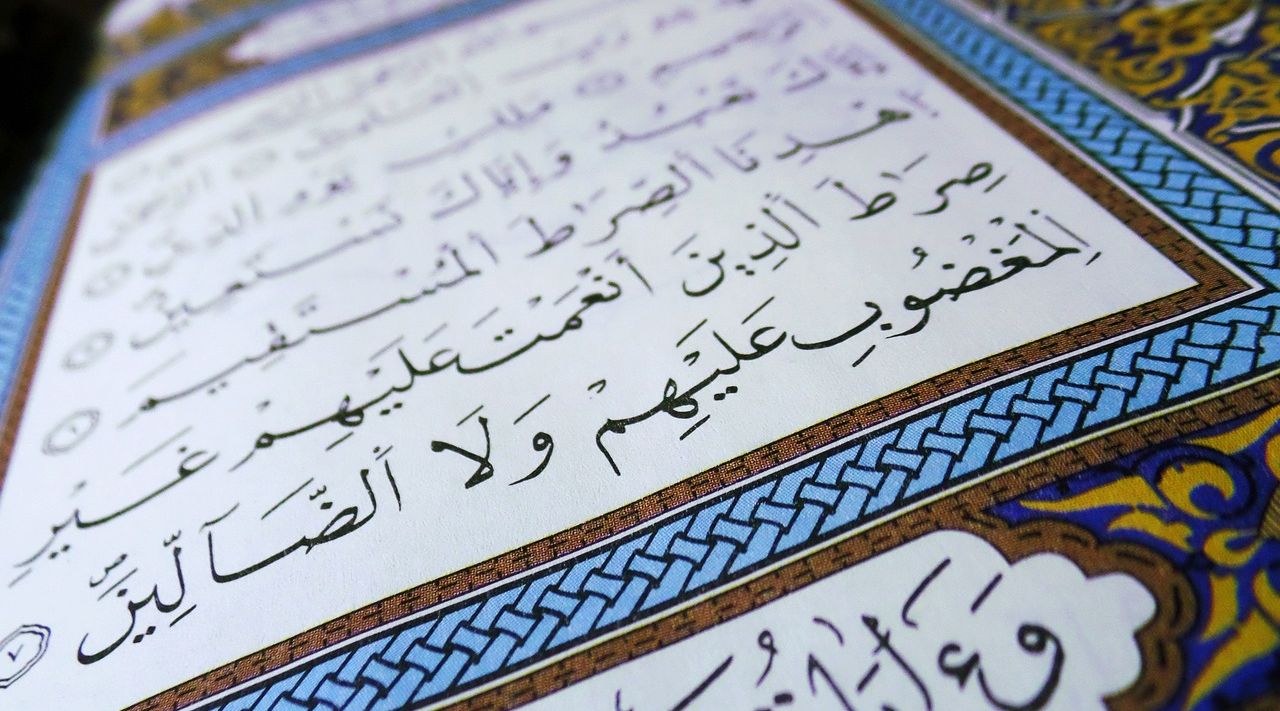
We repeat This Surah at least 17 times every single day. Reflecting on its meaning is essential to attain Khushu` (humility) in our prayers.
Some people feel bored from repeating it. However, the purpose of repetition is to enforce certain meanings and attitudes. Here’s a suggested plan to make sure that you read it with a conscious mind and a humble heart.
You can always direct your OWN thoughts and PLAN on how you want to attain humility and contemplation inside the salah, but I hope that this helps as a starting point:
{In the Name of Allah, the Most Beneficent, the Most Merciful.}
– Always start your affairs with the name of Allah
– His mercy is the first attribute used to introduce Allah to you
{All praise belongs to Allah, the Lord of all the worlds}
– Reflect on His infinite blessings
– A practical tip is to remember one blessing in each rak`ah (unit) of your prayer
{The Most Beneficent, the Most Merciful.}
– The names of mercy occurred FOUR times in a relatively short Surah
– His mercy is the first attribute used to introduce Allah to you.
{Master of the Day of Judgment}
– Reflect on the Day of Judgment
– Remember that this prayer may be the last one before you meet Him.
{It is You we worship and You we ask for help.}
– This Ayah is the CORE of the Surah, and the essence of Tawhid (confirming the one-ness of Allah)
– This is a perfect moment to think about what you want from Allah, and prepare for your upcoming supplication (du`aa’) and wishes
{Guide us to the Straight Path}
– The number ONE request you definitely need from Allah is guidance, and from Him alone.
Remember that If Allah guides you, then the whole world with its temptation won’t matter, so be sincere in your reguest
{The path of those upon whom You have bestowed favor, not of those who have evoked [Your] anger or of those who are astray.}
– Remember that you’re not the only one on the quest for the straight path.
ِGod already blessed many generations before us with guidance. You can read about them in the Quran and in Islamic history. This verse helps you reflect on their lives and ask Allah to follow into their footsteps
– Similarly, many people earned Allah’s wrath and went astray; this Ayah helps you define what you really want from Allah and helps you set up a specific action plan to reach your goals. It also encourages you to seek for good company and friends and stay away from bad influences and friends.
Taken, with kind permission, from the author’s blog.
The post Learn How to Relate Al-Fatihah to Your Life appeared first on About Islam.
source https://aboutislam.net/shariah/quran/quranic-reflections/quran-reflections-1-relate-al-fatihah-life/


Comments
Post a Comment