Al-Idrisi, a Muslim Pioneer of Modern Geography
Early geography and cartography were more art than science.
Although astronomers through their study of the universe were able to theorize about such general geographical concepts like the shape of the earth, early geography was for the most part a product of the imagination: a collection of wondrous fables and marvelous tales of faraway places.
In the 12th century, however, an Amazigh geographer and cartographer named Abu Abdullah Mohammed bin Mohammed ‘Abdullah bin Idris al-Hammudi al-Hassani started the revolution that ultimately led to modern geography.
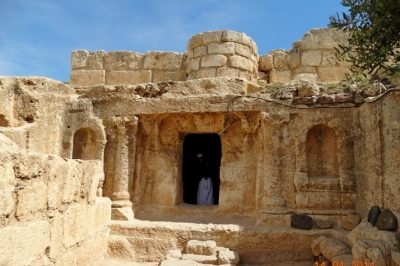
Al-Idrisi was born in 1100 in Ceuta, Morocco, to a noble Amazigh family, the Hammudites. One of his ancestral lines descends directly from Prophet Mohammed, he was entitled to use the title ash-Sharif (the Noble).
During his youth he studied in Cordoba, then the capital of Islamic Spain. A poet, student of medicine and an avid traveler, he was an accomplished genius of the first order.
During his travels he retraced the path of Islamic conquest. The warrior horsemen who had swept across the Mediterranean spreading the new faith, had vowed that only the ocean waves at al-Maghreb (West) would stop their horses.
-
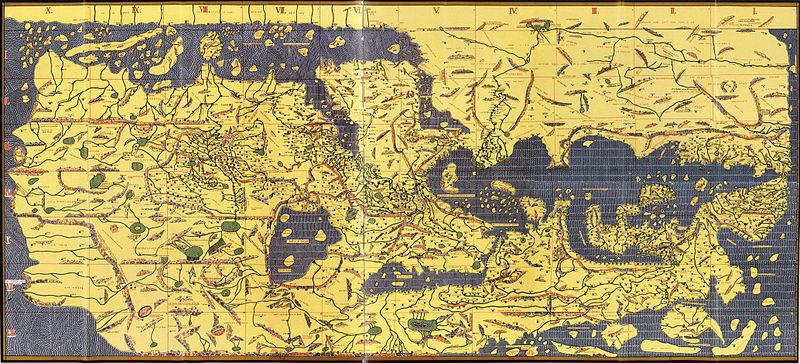
The Tabula Rogeriana, drawn by Al-Idrisi in Cairo, Egypt for Roger II of Sicily in 1154, one of the most advanced ancient world maps.
Al-Idrisi’s adventurous spirit was equal to theirs. He voyaged westward to Madeira and the Canary Islands, stopped only by the immensity of the Atlantic Ocean.
 Read Also: Islamic Philosophy of Science
Al-Idrisi’s reputation for learning, and his fame as a traveler, eventually earned him an invitation from Roger II, the Norman ruler of Sicily, to visit the island.
Received with high honors, al-Idrisi found in Roger a kindred spirit with an intellectual curiosity that matched his own.
The monarch’s insatiable fascination with geography occupied all the time he didn’t spend administering his tiny kingdom.
Prior to Roger’s death in 1154, Al-Idrisi completed construction if a celestial sphere and a disk shaped map of the known world (a planisphere), both of solid silver.
The map was based on the encyclopedic work al-Idrisi completed under Roger’s patronage: the Kitab Nuzhat al-Mushtaq fi Ilkhtiraq al-Afaq, sometimes called the Kitab ar-Rujari (The Book of Roger).
It wasn’t until 1592 that the manuscript made its first European appearance in an abridged edition printed in Rome. It was translated into Latin in 1619 but it has yet to be rendered into English in its entirety.
Other information was obtained from persons sent specifically for the purpose of gathering information.
Al-Idrisi stayed on at the court in Palermo after Roger’s death and wrote another geographical treatise, The Garden of Civilization and the Amusement of the Soul.
This article is from our archive, originally published on an earlier date, and now republished for its importance.
The post Al-Idrisi, a Muslim Pioneer of Modern Geography appeared first on About Islam.
source https://aboutislam.net/muslim-issues/science-muslim-issues/islamic-start-modern-geography/


Comments
Post a Comment