Here’s A Muslim Geographer You Should Know
We are all familiar with names of Western explorers like Marco Polo, Ferdinand Magellan, Vasco da Gama, Columbus and others who have put their names in the history of ocean and sea exploration.
When I was a little girl in primary and secondary school, my teachers told me about their important contributions and participation in building the “Great Western and World Civilization”.
They told us about Marco Polo and his adventures in China, Vasco da Gama and his success in establishing a sea route from Europe to India through Africa’s Cape of Good Hope, Columbus and how he discovered America etc. But they never told us about the eastern explorers who made history before the others did.
 Read Also: Omar Khayyam: Poet With Flair for Numbers
Names like Ibn Battuta, Ibn Majid, Shamsuddin Abu Abdullah al-Moqaddasi, Ibn Fudhlan, Ibn Jubayr, Abu Bakr the Second (King of Mali), Piri Reyes and many other Muslim explorers were never mentioned until I entered university and discovered how important Islam was (and still is) to the world civilization.
I discovered the beauty and the richness of our Islamic civilization with all those many Muslim figures who made history and left their own mark in every field in which they were specialized.
Each ethnic and racial group that embraced Islam made its contribution to the one Islamic civilization to which everyone belonged. One of the Eastern figures that attracted my attention in the world of sea travelers and explorers is the Muslim Admiral Zheng He.
Read Also: Az-Zahrawi: The Great Muslim Surgeon
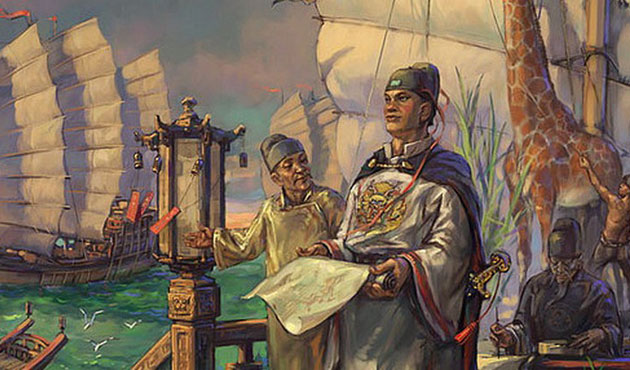
Muslim Admiral Zheng He

Zheng He, the man who discovered America before Columbus did. He was born at the end of the 14th century, in a small town in the region of Yunnan to a Hui-family, which is a Muslim Chinese ethnic group.
His birth name was ‘Ma He’. In China they use “Ma” as a short name for “Muhammad”.
His family claimed to be a descendant of a Mongolian governor in Yunnan or from King Mohammed of Bukhara. Raised as a Muslim, Ma He studied the teachings of Islam and memorized the Quran at an early age. His father and his grandfather completed their pilgrimage to Makkah.
They had a great impact on his education and it’s under their influence that the young Ma He would develop an intense curiosity about the outside world. The travels his grandfather and father undertook would contribute a lot to his education.
Aside from his religious education, Ma He was raised in a family where speaking Arabic and Chinese was something evident.
That means that both languages were his mother tongue. He wanted to know everything about the countries that were geographically located westward of China. He studied their languages, religions, traditions, history and geography.
When Ma He was 10 years old, the army of the Ming Dynasty captured him during their military raids in Yunnan.
They took him to Nanjing and there he did his military training. After that, they took him to Beijing to serve Zhu Di, the Prince of Yan and the 4th son of the founding emperor of the Ming Dynasty.
Click to read more…
The post Here’s A Muslim Geographer You Should Know appeared first on About Islam.
source https://aboutislam.net/muslim-issues/science-muslim-issues/muslim-geographer-learnt-school/


Comments
Post a Comment