Similarities Between Scientific and Religious Extremism
Religion and science are two of the most important governing aspects of the world.
Science aims to understand the natural world, its existence, and its workings, whereas religion deals with the spiritual, and ascribes the existence and the workings of the natural world to a higher being, a deity, or a God.
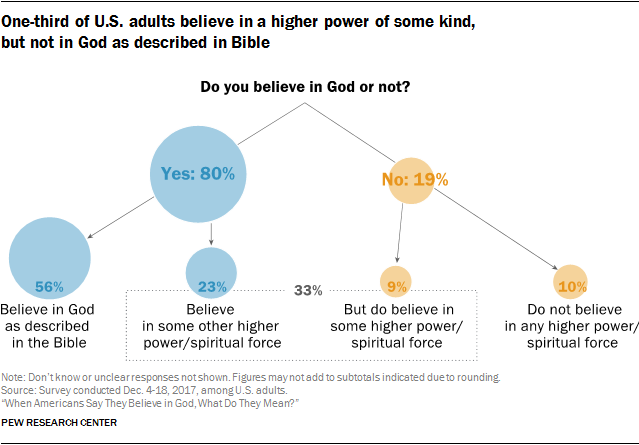
According to surveys, nine-in-ten Americans believe in a higher power. Previous Pew Research Center studies have shown that the share of Americans who believe in God with absolute certainty has declined in recent years, while the share of those saying they have doubts about God’s existence – or that they do not believe in God at all – has grown.
The discrepancy between the two communities is the result of the arrogance brought about by some researchers.
Those who pursue science and labor to find answers to questions believe their research and discoveries render them superior, and that everything can be explained through science.
Islam doesn’t separate the two sides of science and religion. In fact, the Holy Book, Qur’an, is filled with what can now be considered as scientific information. There are accurate descriptions about things that modern science has been able to shed light upon only recently, including information on the formation of the mountains, embryology, botany, biology, and even astronomy.
And what science hasn’t been able to discover is left to the knowledge of the all-understanding and knowing God.
Natural Divine Agents
An article published by Yale University psychologist Paul Bloom suggests that belief in divine agents comes naturally to children. These two aspects are also the foundational features of any religion.
In his book “Why Religion Is Natural and Science Is Not”, one of the founding fathers of the cognitive science of religion, Robert McCauley, claims that human minds are wired to religious beliefs because they have existed for thousands of years, whereas science is a recent development.
Even those who take science as a sacred text and those who claim that evolution is absurd and imbecile are fully aware that there is no answer to many of the mind-boggling questions of the real world and the human mind.
For instance, only 4% of the universe, according to research, consists of energy and matter, and the remaining 96% is considered dark matter and dark energy. In other words, no one knows.
What about the origin of life at conception? How is life breathed into the developing embryo? What about wildlife? What was there before our observable universe? Also what pre-programs some animals’ instinct for independent survival, minutes or even hours after birth? and what allows magnetoception? How can everything be perfectly coordinated?
In addition, science still can’t find an answer to questions man has pondered over for years. Is man the greatest creature? What is the purpose of life? Why are humans here? What is consciousness? These questions are innate to humans and are a part of every individual’s quest for understanding.
Science can’t possibly answer these questions. In fact, science considers consciousness a mere brain activity, whereas research has found consciousness persists beyond the clinical death of an individual.
No Contradiction
Religion definitely doesn’t contradict science. Martin Luther King Jr once said, “Science investigates and religion interprets; science gives man knowledge which is power and religion gives man wisdom which is control.” Science has its doubts and religion is based on faith.
Science, for those who believe in religion, is merely an understanding of the inner workings of the natural world. Although many religions believe in miracles, it’s possible that these miracles had an underlying scientific explanation. Religion certainly doesn’t defy science and its proofs and explanations.
Even the parting of the Red Sea, a miraculous feat conducted by Moses, attracted the scientific community towards developing a plausible scientific explanation for its occurrence.
Researchers analyzed conditions that could have led to the parting of the Red Sea. It is possible that 67 miles per hour winds blowing through the night could have exposed a coral reef lying close to the surface.
Although there is divine intervention, science does not prove everything has been proven by science. Perhaps down the road, we will find scientific explanations for everything that religion dictates.
In conclusion, the scientific community must realize that as a watch needs a watchmaker, creation needs a creator. Even so, there is a difference between a watchmaker and a creator: the watchmaker doesn’t make a watch from scratch.
This article is from our archive, originally published on an earlier date, and highlighted now for its importance
The post Similarities Between Scientific and Religious Extremism appeared first on About Islam.
source https://aboutislam.net/muslim-issues/science-muslim-issues/similarities-scientific-religious-extremism/


Comments
Post a Comment