
‘Our Differences Are the Best Part’: Woman Hopes Australian Can Accept Muslims

Growing up as a hijabi Muslim in Australia, Inaz Janif believes the time has come for those in power to take action against rising hate crimes targeting the religious minority, SBS reported.

“I think people who are influential have to set the bar, they have to set the tone for society and make sure that everybody, no matter where they come from and no matter their characteristics or the unique features they have, are accepted,” she told SBS News.

“I think our differences are the best part of us.”

Janif was particularly worried after the annual Scanlon Foundation report, released last Tuesday, which found negative attitudes about Muslims in Australia remain high.

Though she has never been physically assaulted, verbal abuse is common.

“It’s quite often while driving, even with my children with me, that I’m verbally assaulted. I’ve had my children ask me ‘why is that person so angry mum?’ ‘Why are they saying things about us being Muslim?'” she said.
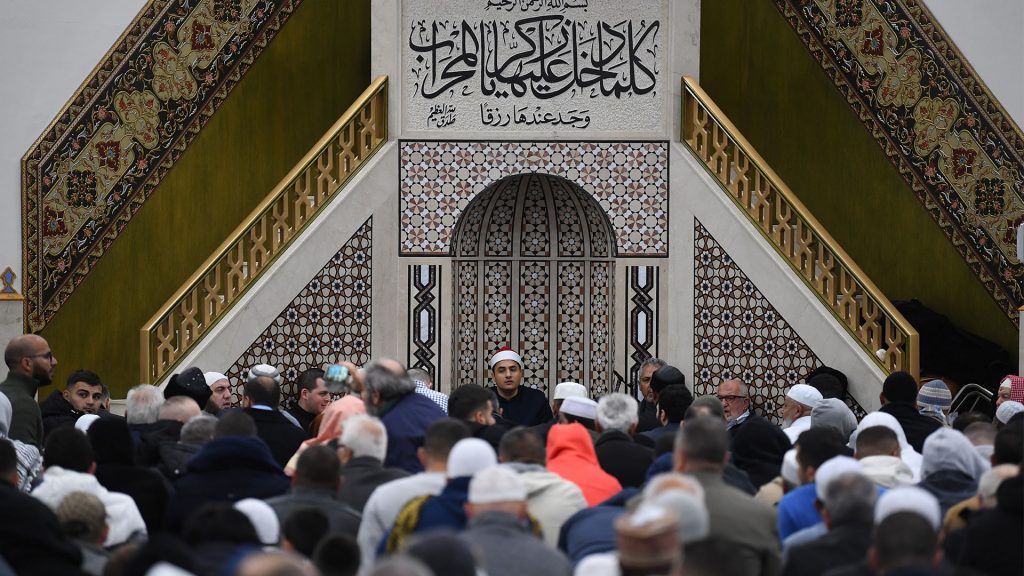
Members of the Muslim community at Lakemba Mosque in Sydney. AAP

Government Action

Supporting Janif’s opinion, Mohammad Al-Khafaji, CEO of the Federation of Ethnic Communities’ Councils of Australia, said anti-Muslim sentiment is an issue the government needs to address.

“That should be a warning sign for all of us, and especially for our political leaders, to make sure that we address this issue before it becomes a bigger problem,” he said.

“We know that there was a recent study released by the Islamophobia Register that has quantified some of those complaints and some of those attacks on people from Muslim backgrounds.

“We need to make sure that there are policies and social cohesion programs in place that facilitate a meeting between people so they understand each other’s differences, each other’s faiths, each other’s cultures.”

According to the 2016 Australian Census, the number of Muslims in Australia constituted 604,200 people, or 2.6% of the total Australian population, an increase of over 15% of its previous population share of 2.2% reported in the previous census 5 years.

Rising Hate

Women wearing a hijab or other Islamic head coverings are overwhelmingly bearing the brunt of public Islam hate attacks, making up almost 80 percent of victims.

Overwhelmingly, the majority of the attacks (75 percent) were perpetrated by Anglo men and NSW has the most reported physical assaults — 60 per cent.

The alarming statistics were revealed by the Islamophobia Register Australia in July 2017, showing 243 verified incidents of harassment between September 2014 and December 2015.

The Islamophobia Register Australia was established in 2014 in response to growing anecdotal evidence of Islamophobic discrimination.

The post ‘Our Differences Are the Best Part’: Woman Hopes Australian Can Accept Muslims appeared first on About Islam.


source https://aboutislam.net/muslim-issues/australia/our-differences-are-the-best-part-woman-hopes-australian-can-accept-muslims/

Comments

Popular posts from this blog

List of Times and Places Where Dua is Accepted

A short reminder regarding the recommended times of dua . And I think what you need to know here is that the recommended times of dua or recommended things that can cause your dua to be accepted, can be divided into two sort of large groups: Am I Good Enough to Make Dua for Myself? Situations where your dua is accepted. Times where your dua is accepted So I’m going to very briefly mention them one after the other as much as possible. As for situations where your dua has been accepted: – The person who has been wronged or oppressed . – A person who finds themselves in severe difficulty after a calamity has struck. – The person who is traveling. – Someone who is fasting. – The one who is reciting the Quran or has just recited the Quran – Someone who is performing Hajj or Umrah or jihad. – The one who is making dua for someone in their absence . Because we know that when you make dua for someone in his absence an angel says: “ Ameen and to you”. – A person...

Derechos de Las Mujeres en Islam

Durante el Tiempo del Profeta (la paz sea con él) Veamos cómo fueron tratadas las mujeres de todo el mundo durante la época del Profeta (la paz sea con él). En la Europa del siglo VIII, la religión principal era el catolicismo y durante este tiempo debatían si las mujeres tenían alma. Dijeron que las mujeres eran impuras y que no tenían derecho a la herencia. A las mujeres tampoco se les permitía tocar la Biblia. No era como ahora en el Islam, donde ellas no pueden tocar el Corán durante la menstruación, pero a las mujeres en la Europa del siglo VIII nunca se les permitió tocar la Biblia. En China e India, fueron quemadas vivas cuando murieron sus maridos. En Arabia Saudita practicaron infanticidio femenino en el que, si nacía una niña, la enterrarían viva. Si el marido de una mujer muere, un miembro de su familia se unirá a ella para demostrar que ahora es de su propiedad. Mujeres en el Islam Con el Islam llegó una nueva era para las mujeres. En el Islam, las mujeres tienen la...

Ghuraba (The Strangers): Nasheed with English Subtitles

Islam began as something strange, and it shall return to being something strange, so give glad tidings the strangers. (Sahih Muslim 145) This famous nasheed has many versions; this one is from Muhammad al-Salman and has the subtitles in English embedded. [We are] strangers and we do not bow the foreheads to anyone besides Allah  […] Transliteration to help in the pronounciation:  Ghurabaa’ wa li ghairillaahi laa nahnil jibaa Aisha Stacey  wrote in an article for Aboutislam.net : “I think that many of you would agree that being Muslim in the 21st century makes you well acquainted with being strange. It might even be a metaphor for random, as in you have been randomly selected. […] many converts to Islam will tell you about feeling as if they were strangers, before finding Islam. They will speak of feeling that they belonged somewhere else that their lives were just slightly off center. They often speak about a vague sense of knowing they were not like everyone else...