The Historic Hajj of Mansa Musa King of Mali
King Mansa Musa is famous for his Hajj journey, during which he stopped off in Egypt and gave out so much gold that the Egyptian economy was ruined for years to come.
Mansa Musa was the great-great-grandson of Sunjata, who was the founder of the Mali empire.
His 25-year reign (1312–1337 CE) is described as “the golden age of the empire of Mali” (Levztion 66).
While Sunjata focused on building an ethnic Malinke empire, Mansa Musa developed its Islamic practice.
He performed his Hajj in 1324. According to Levztion, the journey across Africa to Makkah took more than a year.

Mansa Musa journeyed along the Niger River to Mema, then to Walata, then through Taghaza, and on to Tuat, which was a trade center in central Africa.
Tuat attracted traders from as far away as Majorca and Egypt, and its traders included Jews as well as Muslims.
When he arrived in Egypt, Mansa Musa camped near the Pyramids for three days. He then sent a gift of 50,000 dinars to the Sultan of Egypt before settling in Cairo for three months.
The Sultan lent him his palace for the summer and made sure that his entourage was treated well.
Mansa Musa gave away thousands of ingots of gold, and Egyptian traders took advantage of this by charging five times the normal price for their goods. The value of gold in Egypt decreased by as much as 25 percent.
By the time Mansa Musa returned to Cairo from Hajj, however, he had run out of money and had to borrow from local Egyptian merchants.
Special Traditions
While Mansa Musa was devout, he was not an ascetic. His imperial power was widely respected, and he was feared throughout Africa.
Ibn Battuta’s accounts show that Musa expected the same traditional etiquette of reverence to be performed for him as for any other king.
People who greeted him had to kneel down and scatter dust over themselves.
Even in Cairo, Mansa Musa was greeted by his people in the traditional way.
“No one was allowed into the king’s presence with his sandals on; negligence was punished by death.
No one was allowed to sneeze in the king’s presence, and when the king himself sneezed, those present beat their breasts with their hands” (Levtzion, 108).
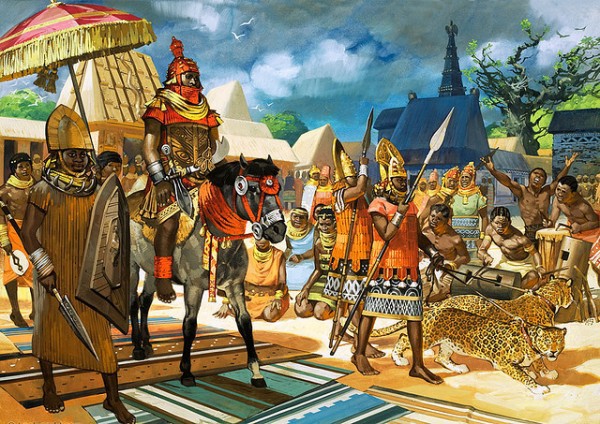
Another custom was that the king would never give orders personally. He would pass instructions to a spokesman, who would then convey his words.
He never wrote anything himself and asked his scribes to put together a book, which he then sent to the Sultan of Egypt.
However, Mansa Musa had to face his own test of humility because it was required, when greeting the sultan, to kiss the ground. This was an act that Mansa Musa could not bring himself to perform.
Ibn Fadl Allah Al-Omari, who spent time with Musa in Egypt, reports that Musa made many excuses before he could be persuaded to enter the sultan’s court.
In the end, he made a compromise by announcing that if he had to prostrate on entering the court, it would be before Allah only, and this he did.
Mansa Musa stood in a long tradition of West African kings who had made pilgrimages to Makkah, and, like his predecessors, he traveled in style.
Ibn Battuta recorded the display of wealth, which included a large presence of bodyguards, dignitaries, saddled horses, and colored flags. He traveled with his senior wife, Inari Kunate, who brought with her five hundred maids-in-waiting.

The senior wife was also respected and feared, and rulers of different cities paid their tributes to her.
However, Ibn Battuta recorded that in Mansa Musa’s court, the Shari`ah was rather informally practiced in matters of marriage.
He records that Ibn Amir Hajib, a member of the Mamluk court, noted how Mansa Musa strictly observed prayer and knew the Qur’an but had maintained “the custom that if one of his subjects had a beautiful daughter, he brought her to the king’s bed without marriage.”
Ibn Amir Hajib informed Mansa Musa that this was not permitted under Islamic law, to which Mansa Musa replied, “Not even to kings?” Ibn Amir Hajib said, “Not even to kings.”
Henceforth, Mansa Musa refrained from the practice.
Building Mosques
Mansa Musa’s Hajj had a significant impact on the development of Islam in Mali and on the perception of Mali throughout Africa and Europe.
He was later accompanied back to Mali by an Andalusian architect, who is said to have designed the mosque at Timbuktu.
He also invited back with him four descendants of the Prophet (peace and blessings be upon him), so that the country of Mali would be “blessed by their footprints.”
According to Levtzion, Mansa Musa’s pilgrimage is recorded in many sources, both Muslim and non-Muslim and from both West Africa and Egypt.
Mali also appeared on the maps of Jews and Christians in Europe. In Mali, Musa is known for building mosques and inviting Islamic scholars from around the Muslim world to his empire (Levtzion 213).
References
- Levtzion, N.Ancient Ghana and Mali. London: Methuen & Co., 1973.
From the archives.
The post The Historic Hajj of Mansa Musa, King of Mali appeared first on About Islam.
source https://aboutislam.net/family-life/culture/historic-hajj-mansa-musa-king-mali/


Comments
Post a Comment