Fulfilled Prophecy of Surat Ar-Rum
Islamophobes go to great lengths to discredit the signs present in the Noble Quran, and the first few verses of Surat Ar-Rum present one of their greatest challenges.
Not only do the verses contain a prophecy that was proven true, this prophecy was one that deemed close to impossible at the time of its revelation.
The following is an English translation of the first five verses of this chapter of the Qur’an – Chapter 30 – together with the transliteration of the original Arabic text.
 Read Also: When in Rome, Do What’s Right – Not Automatically What the Romans Do
God says: {Alif, Lam, Meem(1) The Romans have been defeated (ghulibat-ir-Rum)(2). In the nearest/lowest land (fi adna al-ard). But they, after their defeat, will overcome (be victorious) (wa hom men ba’ad ghalabehem sayaghleboon)(3). Within three to nine years (fi bed’e seneen). To Allah belongs the command before and after. And that day the believers will rejoice (yawma-edhin yarfraho al-mo’menoon)(4). In the victory of Allah (bi-nasri-Allah). He gives victory to whom He wills, and He is the Exalted in Might, the Merciful(5).} Surat Ar-Rum (30).
The verses refer to the defeat of the Byzantine Eastern Roman Empire by the Persian Sassanid Empire in 614-615 A.D, and state that this defeat occurred in the nearest or lowest land. The verses claim that within a period of three to nine years, the Romans would be victorious, and that at that time, Muslims would rejoice with the victory of Allah.
According to Muslim scholars, the verses, revealed at the time of the Roman defeat, contain a promise of a future event.
Because the promise proved true, Islamophobes concentrate their refutations on arguing that a) the verses are not read in the way stated, and b) they were revealed after the Roman victory, and are therefore simply stating events that have already taken place.
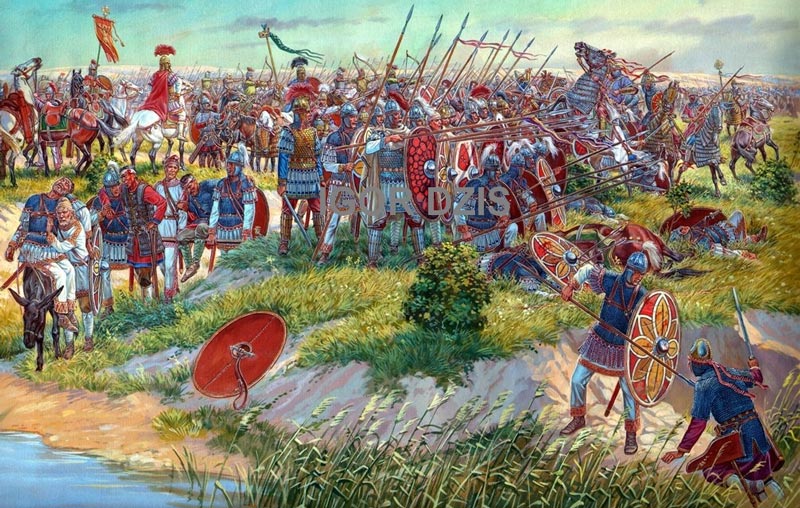
Byzantine-Sassanid War
The final set of Byzantine-Sassanid wars was fought between 602 A.D and 628 A.D. When the Byzantine emperor Maurice was overthrown by his army officer Phocus, Sassanid King Chosroes II declared war on Byzantium. After capturing Damascus in 613 A.D., the Persians took over Jerusalem in 614-615 A.D., where they massacred many Christians, captured the true cross, and destroyed the Church of the Holy Sepulcher [1].
In 622 A.D, Byzantine emperor Herclius began a counter-attack and started winning several victories over Persians.
In 624 A.D, he headed through to the center of the Persian land, where he marched to Azerbaijan and Armenia, burned the King’s palace at Ganzak, and left a trail of burning cities behind him [2].
The final defeat for the Persian army was in the battle of Nineveh in 627, where Romans were able to regain most of their territories back, as well as bring the true cross back to Jerusalem [3].
Click for more:
The post Fulfilled Prophecy of Surat Ar-Rum appeared first on About Islam.
source https://aboutislam.net/muslim-issues/science-muslim-issues/fulfilled-prophecy-surat-ar-rum/


Comments
Post a Comment