Al-Battani (Albategnius): The Trigonometrical Genius
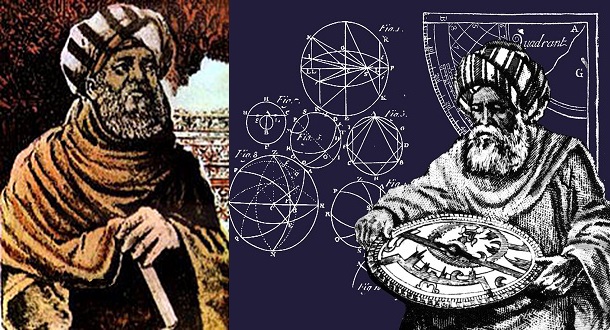
Abu Abdallah Muhammad Ibn Jabir Ibn Sinan Al-Battani Al-Harrani, known in the West as Albategnius, is considered the greatest astronomer of his time and one of the greatest during the Middle Ages.
Al-Battani was born around 858 C.E. in Battan, a state of Harran, and was first educated by his father Jabir Ibn San’an Al-Battani, a well-known scientist. He then moved to Ar-Raqqa, situated on the bank of the Euphrates in Syria, where he received advanced education and began his career as a scholar.
The Fihrist (Index), compiled by the bookseller Ibn An-Nadim in 988, gives a full account of the Arabic literature available in the 10th century and briefly describes some of its authors. It depicts Al-Battani as:
 Read Also: Here’s A Muslim Geographer You Should Know
… one of the famous observers and a leader in geometry, theoretical and practical astronomy, and astrology. He composed a work on astronomy, with tables, containing his own observations of the sun and moon and a more accurate description of their motions than that given in Ptolemy’s Almagest.
In it, moreover, he gives the motions of the five planets, with the improved observations he succeeded in making, as well as other necessary astronomical calculations. Some of his observations mentioned in his book of tables were made in the year 880 and later on in the year 900.
Nobody is known in Islam who reached similar perfection in observing the stars and scrutinizing their motions. Apart from this, he took great interest in astrology, which led him to write on this subject too. Of his compositions in this field, I mention his commentary on Ptolemy’s Tetrabiblos.

Al-Battani’s Kitab al-Zij is by far his most important work. The book contains 57 chapters, beginning with a description of the division of the celestial sphere into the signs of the zodiac and into degrees. The necessary background mathematical tools are then introduced (such as the arithmetical operations on sexagesimal fractions and the trigonometric functions).
Chapter Four contains data from al-Battani’s own observations. Chapters Five through 26 discuss a large number of different astronomical problems – following, to some extent, material from the Almagest. Ptolemy’s theory regarding the motions of the sun, moon, and five planets are discussed in Chapters 27 through 31; however, for al-Battani, the theory appears less important than the practical aspects.
After providing the method for converting data from one era to that of another, al-Battani then devotes 16 chapters explaining how his tables are to be read. Chapters 49 through 55 cover problems in astrology, while Chapter 56 discusses the construction of a sundial. The final chapter discusses the construction of a number of astronomical instruments.
Continue Reading…
The post Al-Battani (Albategnius): The Trigonometrical Genius appeared first on About Islam.
source https://aboutislam.net/muslim-issues/science-muslim-issues/al-battani-trigonometrical-genius/


Comments
Post a Comment