Masjids in the Prophet’s Time and Now: What Has Gone Wrong?
First informal masjid
Early in his prophetic mission, Prophet Muhammad (peace and blessings be upon him) felt the need for a place for congregational prayers as well as for social, cultural, and educational exchanges. Given the cruelties of Makkan oppressors, he and his followers could not gather together or say prayers in public. Meanwhile, with the acceptance of Islam by al-Arqam Ibn Abi al-Arqam (c. 597-675), the number of his adherents reached seven or eight.
 Read Also: 6 Tips for Youth-Friendly Mosques
Al-Arqam offered his house as a sanctuary for the Prophet to pray with, and train, the new converts. Dar al-Arqam (the house of al-Arqam), as it came to be known, was located in a strategic spot where it was relatively safe for the Muslims to meet. It is regarded not only as the first meeting place for Muslims to pray but also as their first educational centre.
First formal masjid
Violence against Muslims in Makkah reached an unbearable level; the Prophet and his companions had to migrate to Madinah in 622 (13th year of prophethood).
There, in the first year of Hijrah (Migration), he and his followers built a public house of worship named Masjid Quba. About three kilometres south of al-Masjid al-Nabawi (the Prophet’s masjid), it has thus far morphed into a large prayer facility.
Within the same year, the Prophet along with his companions built al-Masjid al-Nabawi that became the centre of his religious, educational, and administrative activities.
It was a hub for collective knowledge-building, the Prophet being the main educator. Its “unpretentious and rudimentary structure” catered to “the spiritual, social, educational and political needs” of Muslims (Omer, 2010: 119 & 121).
It was a multi-functional and multifaceted space that played critical roles in the development of the early Muslim community.
Simple and purposeful
Al-Masjid al-Nabawi is currently one of the most magnificent masjids on earth. However, when first built, structurally, it represented simplicity and purposefulness. The modesty and austerity of its structure was proverbial. Once it rained while the Prophet was leading a congregational prayer. The roof of the masjid leaked and the Prophet was “prostrating in water and mud” and there was a “mark of mud on his forehead” (Omer, 2010: 123).
About the architecture and functions of the Prophet’s masjid, writer and theological historian Karen Armstrong (2002: 14) states:
It was a rough building, which expressed the austerity of the early Islamic ideal. Tree trunks supported the roof, a stone marked the qiblah (the direction of prayer), and the Prophet stood on a tree trunk to preach. All future mosques would, as far as possible, be built according to this model. There was also a courtyard, where Muslims met to discuss all the concerns of the ummah – social, political and military as well as religious.
The late British writer Idris Tawfiq comments on the simplicity of the Prophet and on the utter plainness of his masjid which was also his administrative centre. He states:
‘Which one is Muhammad?’ So humble was the Messenger of Allah (peace and blessings be upon him) that strangers looking for him in the mosque in Madinah had to ask this. Sitting in the row of believers for the daily prayers, Muhammad (peace and blessings be upon him), with his simple and modest bearing, could not be distinguished from anyone else. (Tawfiq, 2008: 12)
As a ruler, the Prophet did not have a palace or separate administrative structure. Nor did he have an imposing official residence. The seat of his government was within the walls of al-Masjid al-Nabawi and his residence, within its premise.
Unconventional and effective
At that time, most rulers had palaces that functioned as principal power centres. However, the Prophet went against the flow of the convention. He focused on the effectiveness of his masjid, not on its physical magnificence.
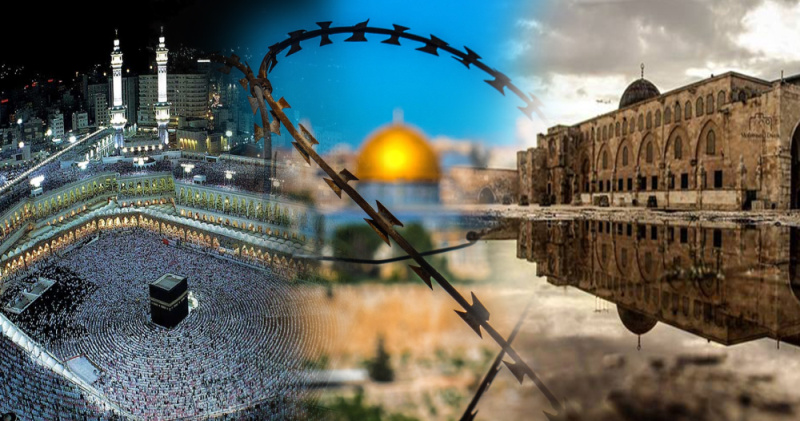
That is not to say that he disliked architectural styles or was opposed to basic, necessary infrastructural amenities. Perhaps, building a magnificent masjid was not a priority then. Nor was it within the means of the then fledgling Muslim community. However, what is important to note is that, the absence of a grand masjid did not prove an impediment to the Prophet to spreading the message of Islam.
The Prophet made optimal use of his masjid. To him, its functions were more important than its architectural form. In other words, form is important but “only inasmuch as it supplements and enhances function” (Omer, 2010: 137).
In the humble setting of al-Masjid al-Nabawi, the Prophet trained his companions who in a few decades changed the face of the world. They helped spread Islam to the farthest corners of the globe. The seed of what later evolved into many civilisations – branching out from the root of Islam – was planted in the Prophet’s masjid.


Comments
Post a Comment