Do You Really Know the Story of Hijrah?
Editor’s note:
In this article, Selma Cook narrates the story of Prophet Muhammad’s Hijrah to Madinah as an informative background for parents. Read the story and narrate it to your kids.
When Prophet Muhammad (peace be upon him) first started to tell people about the message of Islam, he was talking to people who knew him and his good and honest character.
We might think that knowing the piety of the Prophet (peace be upon him) would urge them to believe in the message and follow him (peace be upon him), but the people were living in an environment of many evils.
They were engulfed in idol worship, racism, tribal and family pride, and many types of injustice.
It took great faith and courage for the Prophet (peace be upon him) to trust in Allah and proclaim the message, knowing very well the negative response that would likely follow.
But this was not the only act of faith that the Prophet (peace be upon him) exemplified.
In fact, making the Hijrah to Madina took enormous reliance on Allah and fortitude to face fierce enemies while laying the foundation of a solid Muslim community.
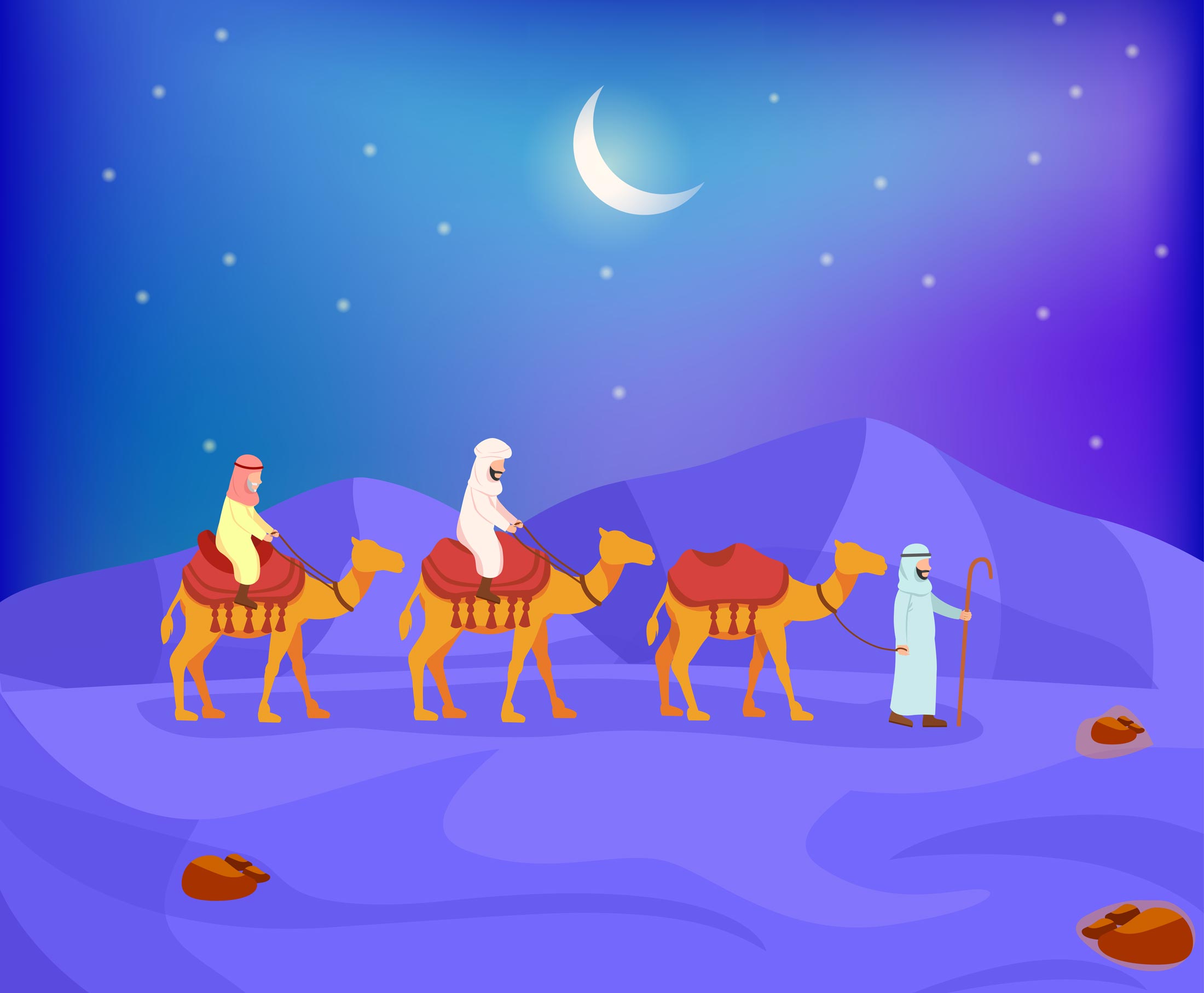
The disbelievers of Makkah were angry when the Prophet (peace be upon him) proclaimed that they should not worship idols.
These idols were made of stone and all sorts of materials (some were even made of dates).
The Prophet (peace be upon him) told them that they should only worship the One true Lord of all Creation who had sent many prophets and messengers throughout time to guide humankind.
Devotion to the stone gods was one reason why many insisted on disbelieving in the Prophet (peace be upon him).

Another important aspect was based on pride, as the Quraysh (the main leading tribe in Makkah at that time), had been, for generations, responsible for providing for the pilgrims who came to Makkah every year at the time of Hajj.
At that time, the Kabah was filled with idols, and the Quraysh thought that if they believed in the Prophet (peace be upon him) and followed him, they would lose respect among the other tribes and this important role that had been given to them by their forefathers would be removed from them.
Moreover, with the pilgrims every year, came much economic wealth.
In following the Prophet (peace be upon him), the people of Quraysh felt they had a lot to lose in worldly terms. Little did they know how much they would lose in the Hereafter if they insisted on their disbelief!
The Beginning of Hijrah
While the Prophet (peace be upon him) was patiently, gently, and persistently proclaiming the message of Islam, his followers suffered under the harshness and severity of the Quraysh who did their very best to persecute and torture the believers, hoping they could force them to give up their faith and return to the worship of idols and immorality.
But the faith and firmness of the believers were exemplary, and they were prepared to face death if they had to in order to remain faithful to Allah Almighty.
After all efforts had been made to change the hearts of the obstinate Quraysh, the time had come for the Muslims to settle elsewhere, and the Prophet (peace be upon him) chose Madinah.
Slowly and secretly the Muslims started to travel to Madinah, trying to keep their movement away from the keen eyes of the Quraysh.
The Prophet (peace be upon him) was waiting for Allah Almighty to order him to leave and travel to Madinah.

It was a sensitive time because Quraysh had reached the peak of anger and frustration at the growing number of Muslims and the fact that Islam was still continuing to spread despite their many efforts to thwart it.
Abu Bakr remained behind in Makkah, waiting for the Prophet (peace be upon him) to receive the order from Allah Almighty to leave. He prepared two camels and provisions for the journey and waited patiently.
Unaware of the Prophet’s (peace be upon him) plans, the Quraysh devised a plot to kill the Prophet (peace be upon him), but Allah Almighty is the Best of planners, and He did not allow the disbelievers to succeed in their evil scheme.
A group of young men, each one representing a tribe of Makkah, stood outside the Prophet’s (peace be upon him) home, intending to strike him one by one when he emerged and kill him.
The Quraysh were proud of their wicked plan, thinking it would rid them of Islam once and for all without them having to answer to the tribe of the Prophet (peace be upon him), who could not retaliate against every tribe!
Allah, the All-Knowing, knew of their plot and guided the Prophet (peace be upon him) to safety.
The Prophet (peace be upon him) asked Ali (may Allah be pleased with him) to sleep in his blessed bed that night, and then, under the protection of Allah Almighty, the Prophet (peace be upon him) left his house and walked past the waiting men.
They did not see him!
And when Ali emerged from the Prophet’s (peace be upon him) house the next morning, they were astonished!
They had no idea how that could have happened. Because they were without true faith, they could not comprehend how it was so easy for Allah Almighty to make such a miracle happen.
The post Do You Really Know the Story of Hijrah? appeared first on About Islam.
source https://aboutislam.net/family-life/moms-dads/really-know-story-hijrah/


Comments
Post a Comment