Forgive & Seize the Days of Forgiveness
Ramadan is the month in which Allah SWT blesses His people with infinite bounty and showers His blessings more than at any other time throughout the year. During this month, all Muslims seek forgiveness and repentance.
Ramadan offers us an opportunity to seek Allah SWT’s forgiveness and to wash off our sins.
Importance of Forgiveness in Islam
There are various verses of the Quran and Hadith of Prophet Muhammad (PBUH) emphasizing the concept of repentance from sins by seeking forgiveness from Allah . Allah SWT says:
“Seek forgiveness from your Lord and repent to Him, [and] He will let you enjoy a good provision for a specified term and give every doer of favor his favor.
But if you turn away, then indeed, I fear for you the punishment of a great Day” [Quran, Surah Hud, 11:3].
In this verse, Allah SWT commands people to seek forgiveness and repent. The effort has dual benefits.
First, it shows that a believer is conscious of Allah (SWT). Secondly, as is evident from the above-quoted ayah, Allah SWT will grant blessings and favors to those who repent and seek forgiveness.
Allah SWT says,
“But indeed, I am the Perpetual Forgiver of whoever repents and believes and does righteousness and then continues in guidance.” [Verse 82; Surah Taha]
Allah SWT talks about one of His qualities, which is His ability to forgive. As Muslims, we must never despair or lose hope about forgiveness, which is one of the qualities of Allah SWT.
Prophet Muhammad (PBUH) said in one hadith,
Narrated by Abdullah ibn Abbas, the Prophet Muhammad (PBUH) said:
“If anyone continually asks pardon, Allah will appoint for him a way out of every distress, and a relief from every anxiety, and will provide for him from where he did not reckon”
[Book 8, Hadith 1513; Abu Dawood].
Here the hadith gives the benefit or virtue of seeking forgiveness.
If someone is always seeking forgiveness from Allah SWT, then He makes their life easier by removing all the troubles and distress they are going through in their lives while also providing sustenance to them.

Seeking forgiveness will help in improving their life and relationship with Allah SWT, after cleansing past sins.
In Ramadan, Muslims can strive to do the following:
Offer Regular Prayer
In Ramadan or any other month, offering regular prayers is actually the best way to seek forgiveness from Allah SWT.
All Muslims should ensure that they are offering their obligatory prayers regularly. After every prayer, it’s advised to supplicate to Allah SWT for pardon and mercy.
Muslims must never miss a prayer, especially in the blessed month of Ramadan, to make sure that no prayer goes without seeking forgiveness.
Attend Night Prayer
Qiyam prayers (optional night prayers) are special Ramadan-specific prayers. They give us an additional chance to praise Allah SWT and seek forgiveness and mercy from Him.
Qiyam prayers are a Sunnah of Prophet Muhammad (PBUH), which carries great reward and is greatly valued in the court of Allah SWT as well. Make an effort to offer Qiyam every night after the obligatory prayer of Isha.
This can be done at home or in congregation. Specifically ask for forgiveness afterwards to ensure Allah will forgive you.
Remembrance Before Asking for Forgiveness
It is imperative for a Muslim to lay a foundation of praising and worshiping Allah SWT in order to seek His pardon.

Tasbeeh (remembrance) is a form of supplication, praise, and worship that can be exercised throughout the day.
It can be done to praise Allah SWT, afterwards supplicating by seeking forgiveness.
Tasbeeh of forgiveness is another option by which a Muslim can ensure that they are seeking forgiveness from Allah SWT throughout the fasts during the holy month of Ramadan.
Read and Learn Quran
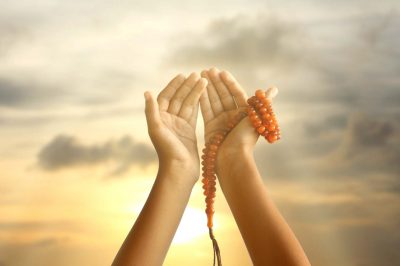
The other great way to seek forgiveness from Allah SWT is to read and recite the Holy Quran along with its meanings.
Reading the Holy Quran regularly will help us get closer to it, understand it, and most importantly, start implementing the instructions in our day-to-day lives.
This good habit automatically restricts many wrongdoings. This will also help in developing a strong connection with the Quran.
The Prophet Muhammad (PBUH) said:
“The best among you (Muslims) are those who learn the Qur’an and teach it.” [Sahih Bukhari, Hadih 545, Book 61]
Improving or Perfecting Ablution
Improving and perfecting ablution increases the chances of acceptance of all kinds of prayers. It results in a better connection with Allah SWT.
Fasting
Anyone who fasts in Ramadan with true spirit, faith, and with the firm belief to seek forgiveness and reward from Allah SWT, then Allah SWT forgives all their sins.
Thankfulness
Thankfulness means, for example, eating food or wearing clothes and thanking Allah SWT with firm belief that it is only in Allah SWT’s control to give good food and clothes, and we have no power to do it to ourselves.
Understanding this and being thankful for His blessings will make Allah SWT happy that His people have belief in Him and look forward to His blessings whenever they need anything in their lives.
The Bottom Line
A Muslim must be involved in acts of virtue throughout Ramadan.
We must also seek forgiveness from other people if we have ever hurt or harmed them, whether intentionally or unintentionally.
If we forgive others, gain their forgiveness, and seek Allah SWT’s forgiveness as well, then it is very likely that Allah SWT will forgive us so that we may enter Jannah with the believers.
After every action, ask Allah to forgive you for all the past sins.
May Allah SWT grant us forgiveness and make this world and the hereafter a better place for everyone.
This article is from our archives.
Read more:
The post Forgive & Seize the Days of Forgiveness appeared first on About Islam.
source https://aboutislam.net/family-life/self-development/forgiveness-seize-opportunity-ramadan/


Comments
Post a Comment