Near-Death Experiences: An Islamic Perspective
Transcribed by Muslim News Staff
Is it metaphysics?
Is it supernatural?
Is it pseudoscience?
Is it real?
Is it a sum of psychological hallucinations or a physiological disorder or both?
Could it fall under the category of the phenomena studied by the field of Parapsychology?
All these are questions that are raised just by mentioning “Near-Death Experiences” (NDE). NDE is a widespread documented phenomenon that takes place among some human beings, but so far science has no scientific explanation for it, and at the same time scientists are unable to deny its existence.
So far, it’s defined as an experience in which a person gets close to the actual physical meaning of death. This person may be undergoing a major surgery, or suffering from trauma or a serious disease which could lead to death.
During this period of suffering or illness, a person going through a Near Death Experience perceives events and scenes that seem to be impossible, unusual or supernatural. This is not to be mixed with Lucid Dream.
Here we join a ten-minute interview with Dr. Shabir Ally, the President of the Islamic Information & Dawah Centre International in Toronto, Canada, where he tackles the difficult topic of NDE from an Islamic perspective, based on an objective scientific background.
Host: Safiyyah Ally, of “Let The Quran Speak”
Guest: Dr. Shabir Ally.
-
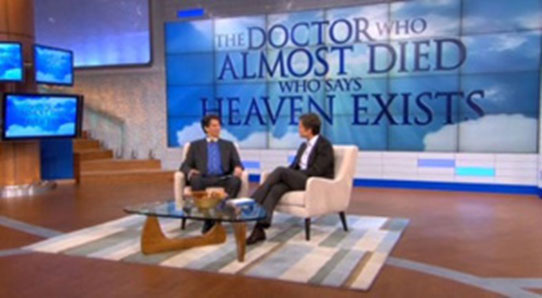
Supernatural explanation of NDE suggests that the person actually experiences and remembers things that happen to his/her disembodied consciousness.
****
Q: A Harvard neurosurgeon, Eben Alexander, became a believer in the afterlife after he had a Near-Death Experience. His experiences are surprisingly common, they include out of body sensations, images of events, religious figures, even heaven.
What lies behind these experiences?
Here with me to answer these questions brother Shabir Ally, President of the Islamic Information Centre.
Brother Shabir, maybe you could first begin by describing what a Near-Death Experience is, because some people might not be aware what it is.
Dr. Shabir: In the 1960s, Dr. Raymond Moody began a series of publications in which he highlighted the experiences of many people who may reach a situation that is very close to death. In that situation, the person comes back out of it with the memory that he or she had been outside of the body. This is sometimes referred to as OBE, or an Out of Body Experience.
Sometimes a person was on the operating table and comes back describing his or her hovering over it, with the body still on the operating table, and seeing what the doctors are doing to his or her body.
In some extreme cases, we have reports where a person might have been pronounced “clinically dead” and then the person is somehow surprisingly revived. And this person may come back with some memory of having been out of the body and having met God or met Jesus or went through a tunnel of unimaginable brightness and having comeback.
Sometimes these individuals turn their lives around following this event. They feel themselves to have been called by God and been sent back to Earth not only to live a wholesome and a righteous life, but also to call people to a similar sort of life.
Click to read more…
The post Near-Death Experiences: An Islamic Perspective appeared first on About Islam.
source https://aboutislam.net/muslim-issues/science-muslim-issues/near-death-experiences-islamic-perspective/


Comments
Post a Comment