Madinah: Microcosm of Islamic Message and Civilization
This article presents a broad conceptual framework that allows us to comprehend and appreciate both the spiritual and urban components of Madinah.
Madinah was as much an abstraction as an urban wonder, so to experience it to its fullest, one must find a balance between the two. Not giving the right attention to each side will be a disservice to Madinah and will result in a person not having the right understanding and appreciation.
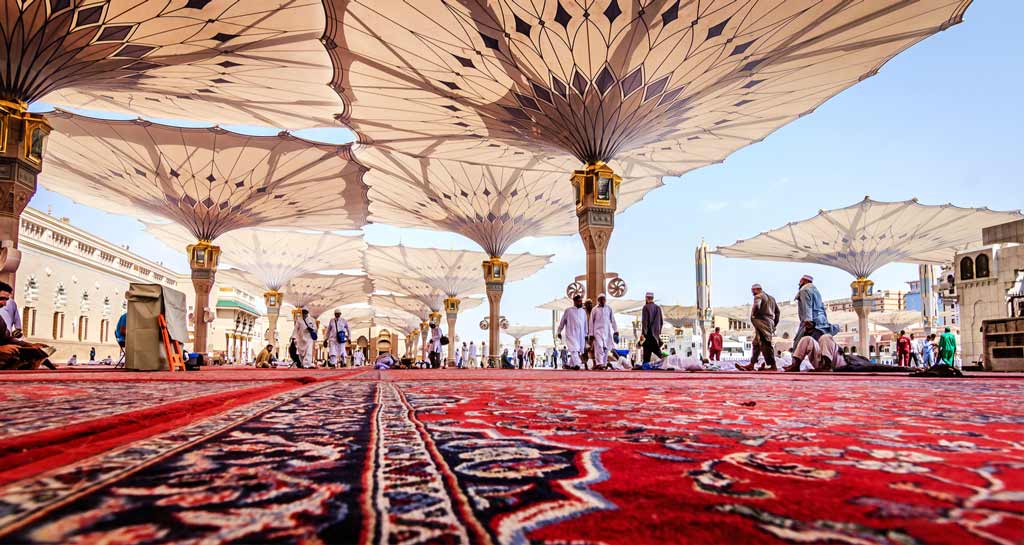
To begin with, Islam is the religion of genuine civilizational awareness and refinement. Thus, one of the reasons for the migration (hijrah) from Makkah, which initially proved inadequate for meeting the requirements of Islam’s inherent enlightenment and sophistication penchant, was to find a more suitable milieu for cultivating the character of the Islamic mission and the identity of its increasing followers. After a period of searching, Madinah established itself as an appropriate and inviting place.
At first, there was no Madinah as an integrated and organized urban community. There was merely a geographical area called Yathrib that consisted of several loosely interrelated settlements. It was anything but a cohesive or progressive society. The Prophet (PBUH) was the one who named the place “Madinah“, which means “the City.”
Advancing Yathrib to Madinah was consistent with the Prophet’s vision for the place and its people. It was also in harmony with the newly created obsessions and aspirations of the populace, echoing the overall atmosphere that could be felt in the air. Madinah was shaping itself as a precursor for the future, as a template for what lay ahead. It was to become an embodiment of the Islamic understanding of civilizational maturity and cultural panache.
Madinah, moreover, became a benchmark as a wellspring from which the essence of all the future development blueprints in Muslim societies originated and to which they all eventually returned for the validation and authentication ends.
At first, Madinah was the personification of the Islamic message, but it quickly became the microcosm of Islamic culture and civilization as well. In fact, the former was the harbinger, plus the vitality and lifeblood of the latter.
That is why the word “Madinah” is derived, amongst other things, from the expressions “Maddana“, and “Tamaddun“, which signify “to civilize” and “civilization“, respectively. Hence, the meanings contained in the word Madinah are “urbanity“, “class“, and ‘civilization.”
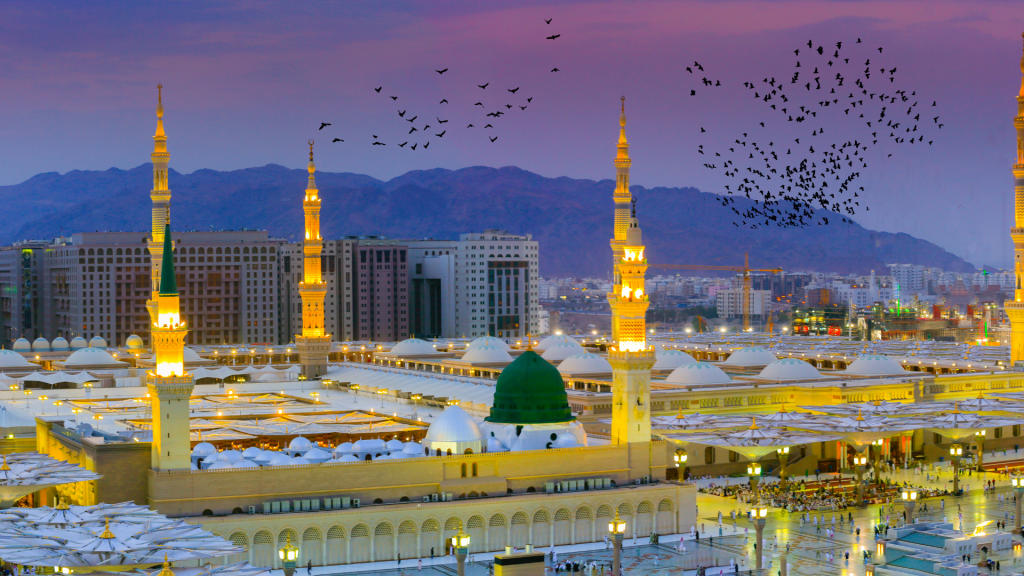
That is why, furthermore, Madinah later came to be known as “al-Madinah al-Munawwarah” which means “Luminous City”, with the word “City” standing for Madinah’s ground-breaking civilizational (physical) dimension and the word “Luminous” for its revolutionary spiritual and also enlightening aspects.
Madinah is likewise known as “Madinatu Rasulillah”, which means “the City of Allah’s Messenger”, implying that Madinah’s sheer existence as it is and everything the city has
ever been exclusively due to the Prophet’s divine calling and his exceptional modelled-by-revelation personality.
As a locus of recurring divine interventions and the foremost receptacle of revealed wisdom and guidance, Madinah itself became a holy city. Madinah has loads of beautiful names, as many as ninety-four, according to al-Samahudi (d. 1505), the greatest and most trustworthy historian of Madinah. Standing out among those names are:
“Taybah” (the Pure), “Tabah” (the Good), “the home of Hijrah or migration” and the home of Sunnah, “the home of Salamah (safety, security and integrity)”, “the home of healing (Shifa)”, “Allah’s land”, “the Queen of cities”, and the Refuge of faith (Iman)”.
This means that Madinah, generally, is a good, pleasant, pure, prosperous, safe, and therapeutic city. It is an ideal city and a perfect state, or a utopia, realized. It is a synthesis of the “City of God” and the “City of Man”, whereby the former functions as the cause and criterion and the latter as the effect and end product. Certainly, the “City of God” cannot be actualized on earth without the favourable disposition of the “City of Man”, just as the “City of Man” cannot even come to be without the creational divine influence of the “City of God.”
This harmonious state of Madinah is an antithesis to St. Augustine’s and Rome’s bifurcation of the elected “City of God” and the damned “City of Man”, and to Le Corbusier’s humanocentric and capitalism-oriented “Ville Contemporaine” (Contemporary City) as a modernist model city for the future.
No wonder the latter was perceived as an assemblage of perfectly engineered and highly functional urban “machines” (buildings, especially houses) to live and work in. If St. Augustine’s objective was an impractical abstraction and spiritualization of man, Le Corbusier’s objective was the polar opposite: the mechanization and
subsequent degradation of human talents and value.
The huge number of Madinah’s beautiful and consequential names points towards the distinguished repute of Madinah not only on earth but also in the spiritual kingdom. Such was the inference of al-Samahudi in his magnum opus on Madinah, titled “Wafa’ al-Wafa bi Akbar Dar al-Mustafa.”
The sheer proliferation of nomenclatures for Madinah demonstrated that the city’s true nature was beyond the power of human verbalization. Madinah’s uniqueness and spirit could not be expressed in words.
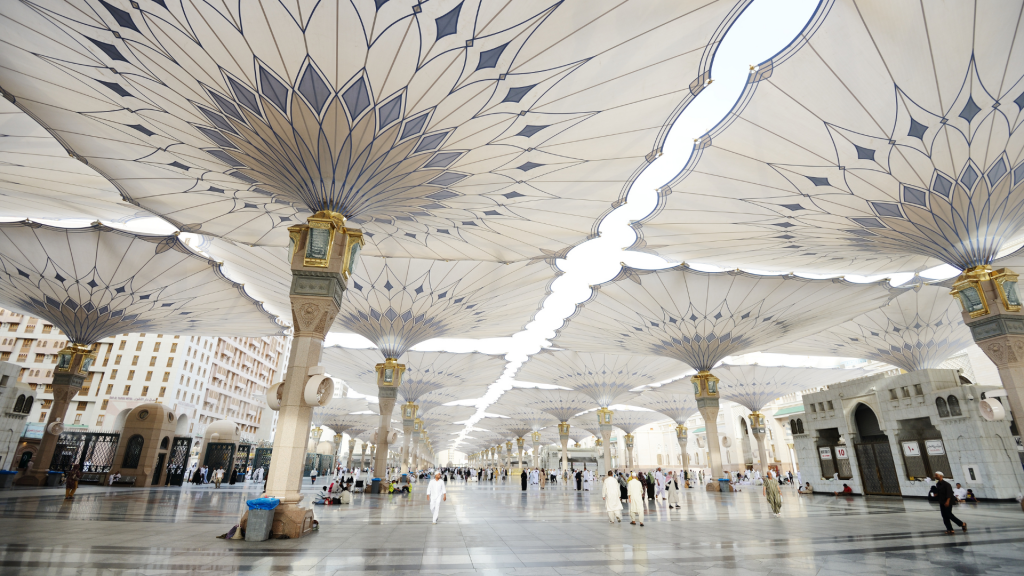
That is so regardless of what people may do to Madinah or what Madinah may undergo on account of the vicissitudes of time and space. Indeed, there were times when Madinah was afflicted by natural or man-made disasters, such as famine, insufficient precipitation, and wars, but never in the slightest was its true spiritual, psychological and historical forte affected thereby. The two sets of metiers operate at two different levels, and human experiences and appreciation of them.


Comments
Post a Comment