
Hajj 1442: Pilgrims ‘Stone the Devil’ with Sanitized Jamarat

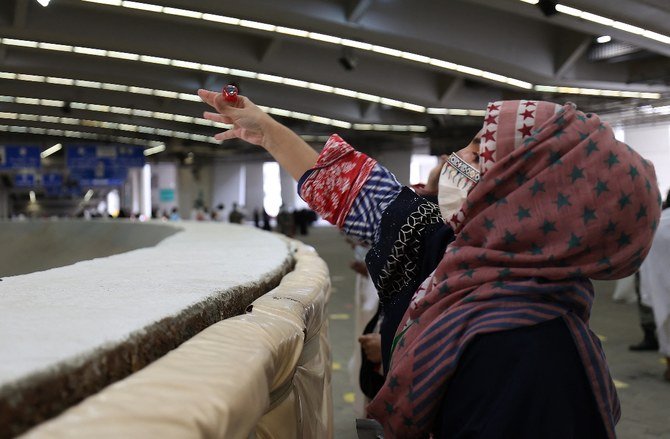
Pilgrims continued, on the second day of `Eid Al-Adha, Wednesday, July 21, the symbolic stoning of the devil at Jamrat Al-Aqaba.

Chanting “Allahu Akbar (God is Greatest),” pilgrims used specially sterilized pebbles obtained ahead of the hajj season.

The stoning of the devil began on Tuesday, July 20, after the pilgrims had slaughtered sacrificial animals and performed Tawaf Al-Ifadah.

📚 Read Also: Hajj In Pictures: Pilgrims Ascend Mount Arafat

Wearing masks and the ihram, the limited number of pilgrims stood while observing physical distancing along a giant pedestrian bridge that houses the walls in the Mina valley, pelting Jamrat Al-Aqabah, Agence France Presse reported.

“All my life I dreamt of going on the hajj, and I still can’t believe that the dream has come true,” 38-year-old Syrian pilgrim Lina told AFP, describing it as “the happiest day of my life”.
Downsized Hajj

In previous years, however, some 3 million white-clad pilgrims from across the world flocked to Islam’s holiest sites to attend haj.

“From the beginning, our priority has been the safety of pilgrims, and for this reason we decided to limit their numbers to 60,000 to ensure that the precautions are enforced and everyone is safe,” Saudi Health Minister Tawfiq Al Rabiah told AFP.

“We are monitoring the situation continuously,” he said late Monday.

📚 Read Also: Hajj 101: How Muslims Perform Hajj?

Pilgrims hurl seven pebbles from behind a fence or from an overhead bridge every day for three days at each of the three 18-meter (58-foot) high concrete pillars symbolizing the devil.

Muslims believe Satan appeared on the same site to Prophet Abraham, son Isma’il, and wife Hagar, who each threw seven stones at the devil.

After the stoning ceremony, the pilgrims head to Makkah for Tawaf Al-Wadaa.

Muslims from around the world pour to Makkah every year to perform hajj, one of the five pillars of Islam.

Due to the COVID-19 pandemic, Saudi government cut the number of pilgrims to only 60,000 to curb the spread of the deadly virus.

Hajj consists of several ceremonies which symbolizes the essential concepts of the Islamic faith. They also commemorate the trials of Prophet Abraham and his family.

Every able-bodied adult Muslim who can financially afford the trip must perform hajj at least once in a lifetime.

The post Hajj 1442: Pilgrims ‘Stone the Devil’ with Sanitized Jamarat appeared first on About Islam.


source https://aboutislam.net/muslim-issues/world/hajj-1442-pilgrims-stone-the-devil-with-sanitized-jamarat/

Comments

Popular posts from this blog

List of Times and Places Where Dua is Accepted

A short reminder regarding the recommended times of dua . And I think what you need to know here is that the recommended times of dua or recommended things that can cause your dua to be accepted, can be divided into two sort of large groups: Am I Good Enough to Make Dua for Myself? Situations where your dua is accepted. Times where your dua is accepted So I’m going to very briefly mention them one after the other as much as possible. As for situations where your dua has been accepted: – The person who has been wronged or oppressed . – A person who finds themselves in severe difficulty after a calamity has struck. – The person who is traveling. – Someone who is fasting. – The one who is reciting the Quran or has just recited the Quran – Someone who is performing Hajj or Umrah or jihad. – The one who is making dua for someone in their absence . Because we know that when you make dua for someone in his absence an angel says: “ Ameen and to you”. – A person...

Derechos de Las Mujeres en Islam

Durante el Tiempo del Profeta (la paz sea con él) Veamos cómo fueron tratadas las mujeres de todo el mundo durante la época del Profeta (la paz sea con él). En la Europa del siglo VIII, la religión principal era el catolicismo y durante este tiempo debatían si las mujeres tenían alma. Dijeron que las mujeres eran impuras y que no tenían derecho a la herencia. A las mujeres tampoco se les permitía tocar la Biblia. No era como ahora en el Islam, donde ellas no pueden tocar el Corán durante la menstruación, pero a las mujeres en la Europa del siglo VIII nunca se les permitió tocar la Biblia. En China e India, fueron quemadas vivas cuando murieron sus maridos. En Arabia Saudita practicaron infanticidio femenino en el que, si nacía una niña, la enterrarían viva. Si el marido de una mujer muere, un miembro de su familia se unirá a ella para demostrar que ahora es de su propiedad. Mujeres en el Islam Con el Islam llegó una nueva era para las mujeres. En el Islam, las mujeres tienen la...

Ghuraba (The Strangers): Nasheed with English Subtitles

Islam began as something strange, and it shall return to being something strange, so give glad tidings the strangers. (Sahih Muslim 145) This famous nasheed has many versions; this one is from Muhammad al-Salman and has the subtitles in English embedded. [We are] strangers and we do not bow the foreheads to anyone besides Allah  […] Transliteration to help in the pronounciation:  Ghurabaa’ wa li ghairillaahi laa nahnil jibaa Aisha Stacey  wrote in an article for Aboutislam.net : “I think that many of you would agree that being Muslim in the 21st century makes you well acquainted with being strange. It might even be a metaphor for random, as in you have been randomly selected. […] many converts to Islam will tell you about feeling as if they were strangers, before finding Islam. They will speak of feeling that they belonged somewhere else that their lives were just slightly off center. They often speak about a vague sense of knowing they were not like everyone else...